
 English
 Español
 Jul 17,2026
A packaging supervisor once told me: “We lose more time on the corner pasting station than on the entire forming line.” He was running a mid-size luxury packaging facility, producing gift boxes for premium spirits. The corners were pasted by hand, each operator managing maybe four boxes per minute. The forming section, fed by a semi-automatic wrapping machine, could easily handle triple that speed. But the corners held everything back. The result? A daily bottleneck that left a clean, high-speed forming zone standing idle while the paste-up team rushed to catch up.
This story isn’t rare. In rigid box manufacturing, the transition from corner pasting to final forming often becomes the weakest link—technically invisible on a layout drawing, painfully obvious on the shop floor. Let’s walk through the actual flow, see what breaks between corner and box, and how a seamless integration of steps changes the equation.
Why the Corner Defines the Box
Before a rigid box takes its final rectangular shape, it passes through a series of steps that all depend on one seemingly small operation: corner pasting. The grayboard is scored and die-cut, a strip of glue is applied to the corner flaps, the flaps are folded and pressed—and then the whole carcass moves forward to wrapping and forming.
When the corner isn’t perfectly square or the adhesive isn’t evenly distributed, the defect travels downstream. A 0.5 mm misalignment at the corner translates into visible bulging under the wrap paper. Glue overflow migrates onto the face of the board, causing wrap material to wrinkle. The moment a box reaches the forming station with a distorted corner, the entire piece becomes a reject. According to a 2022 technical report by the European Carton Makers Association (ECMA), corner defects remain the leading cause of rigid box waste, accounting for over 30% of in-process rejection across surveyed plants. Small corner, big consequence.
The Four-Stage Flow, Rethought
Most rigid box production lines, whether manual or automated, follow the same core sequence. The trouble rarely lies in what the stages are; it lies in how they hand over to each other. For clarity, we’ll examine the flow from a “whole line” perspective, not as isolated islands.
1. Board Preparation and Corner Pasting
The process starts with die-cut grayboard panels. Grooves are already pressed in; the board just waits to become a box skeleton. Corner pasting applies hot melt or cold glue to the flaps, folds them over the adjacent wall, and applies momentary pressure to set the joint.
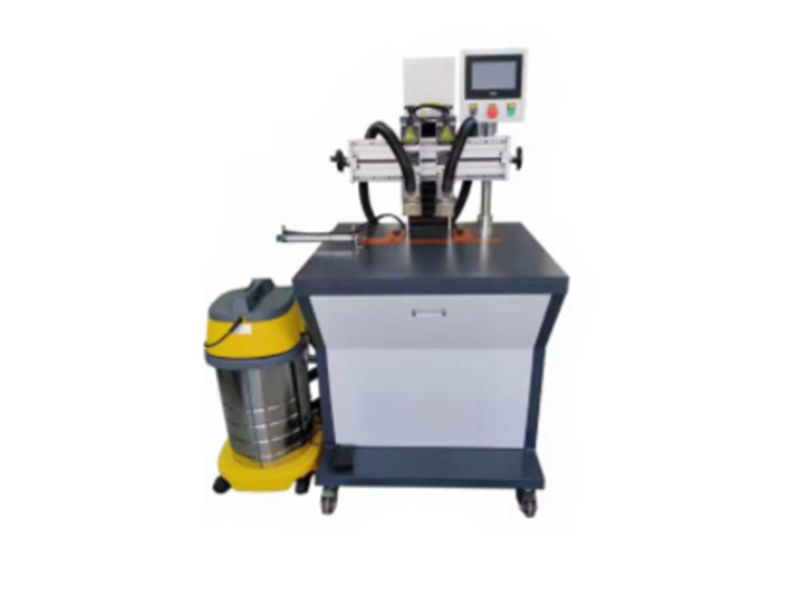
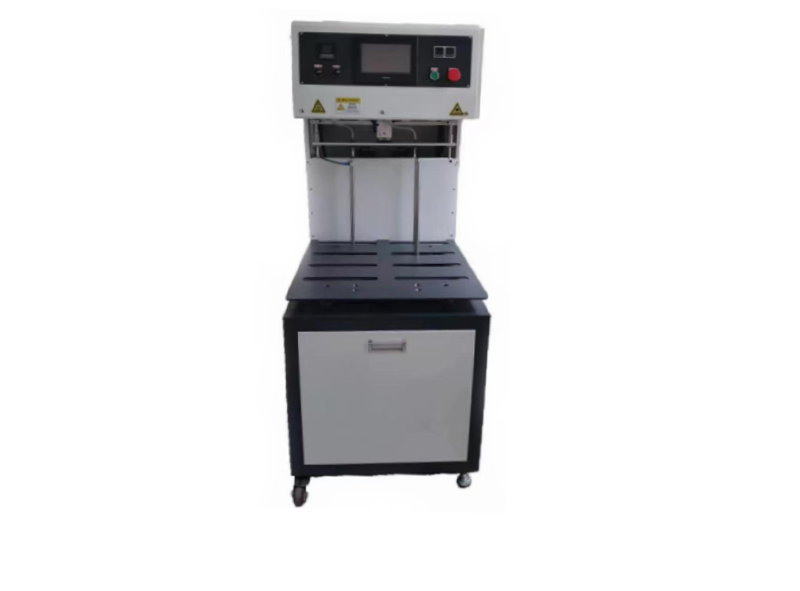
Real-world snag: In many plants, corner pasting is done by standalone gluing machines—or still manually—and the pasted boards are then stacked in batches before entering the wrapping stage. That batching breaks the rhythm. Glue cools down; boards shift in the stack; corners that were perfectly square five minutes ago slowly relax out of alignment. Here, the concept of “flow” is broken right at the start. If you’re exploring how to move beyond piecemeal processing, an integrated corner pasting and forming configuration can help maintain the thermal and geometrical consistency from the very first flap.
2. Wrapping the Base Paper
A pre-cut sheet of covering material—often art paper, textured stock, or leatherette—receives glue on its inner surface, and the pasted grayboard carcass is centered and pressed onto it. The edges of the material are then folded over the board edges in a specific sequence: long sides first, then short sides, with precise mitering at the corners to avoid overlapping bulk.
The hidden link to corner pasting: If the carcass corner is not perfectly rigid, the folding forces during wrapping will push the corner inward, creating a “soft” corner that feels structurally weak even after the box is fully formed. The wrapping step exposes every flaw that originated ten seconds earlier at the gluer.
3. Inner Tray or Lid Assembly
For two-piece boxes, the lid and base travel through mirror workflows. For boxes with an inner tray—common in phone and jewelry packaging—the tray is formed separately and then inserted. This stage is highly repetitive and demands repeatable pressure dwell times to bond the inner liner without bubbles.
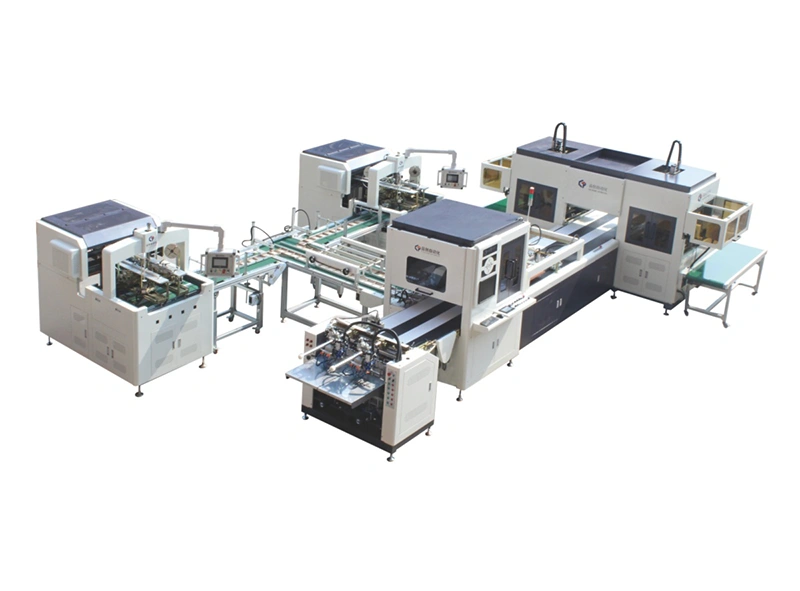
Where the flow stalls: Insertion and pressing are frequently split into two separate stations with manual transfer in between. Even a 5-second manual transfer per box adds up to over 80 minutes of lost production time across an 8-hour shift for a line targeting 1,000 boxes per day. The smarter approach is to treat tray forming and insertion not as a side process but as an organic part of the main forming flow, something that a unified high-speed rigid box assembly system is engineered to do without handovers.
4. Final Forming and Pressing
The last stage marries the lid with the base (if they are produced separately), applies a final compression to eliminate any residual spring-back in the board, and often includes a brief visual inspection or automatic ejection of out-of-spec units. For magnetic closure boxes, magnet insertion and alignment happen just before final closing.
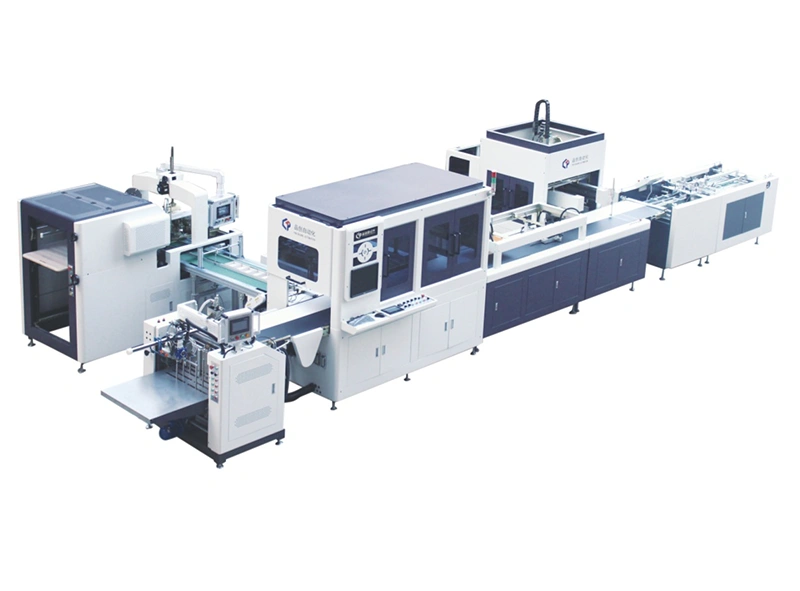
The payoff of an integrated flow: When corner pasting feeds wrapping, wrapping feeds tray insertion, and insertion feeds final pressing in one continuous motion—without intermediate stacking or manual buffering—the tolerance chain remains closed. A box that leaves the line has effectively been “held in place” since its first corner bond set. Operators I spoke with at a luxury electronics packaging facility observed that shifting from a segmented line to a continuous sequence cut their quality complaints related to lid alignment by over 70% in the first quarter, based on internal audit data they were willing to share.
Common Pitfalls That Break the Flow
Even with a clear flowchart on the wall, three systematic mistakes keep showing up on factory visits.
-
Over-buffering between stations: It’s natural to want a buffer in case a station stops. But for rigid boxes, every buffer introduces variable dwell time for adhesives and variable exposure to ambient temperature and humidity. A 20-minute buffer can mean the difference between a corner that holds its shape and one that slowly peels open.
-
Decoupled glue temperature control: Corner pasting glue, wrapping glue, and liner glue often run on separate temperature control units. If one unit drifts—and glue viscosity changes—the handshake between stations fails. The box doesn’t reject itself; it just turns into a customer complaint a week later when the corner gives way.
-
Ignoring forming die condition: The forming plungers and creasing tools wear in a pattern that mirrors production volume. Many teams replace them on a fixed-time schedule, but actual wear depends heavily on the board’s grammage and recycled content. A simple digital counter per station, combined with periodic dimensional checks of the first box of each hour, prevents the gradual drift that eats into margins.
Addressing these three points doesn’t require a massive capital overhaul. It requires a mindset that treats the entire corner-to-forming path as one single cell, not a series of “good enough” handshakes.
What an Optimized Flow Looks Like
An optimized rigid box flow has a few unmistakable signatures: the line stops only for a changeover, not for clearing jams between stations. The corner pasting unit communicates with the wrapping unit through a shared encoder signal, so both accelerate and decelerate together. The operator’s job shifts from transporting boards to monitoring the few things that still require a human eye—glue pattern consistency, board warpage, and final cosmetic finish.
From a production data standpoint, one target to aim for is a direct-pass yield (DPY) above 98.5% from corner pasting to finished box, measured at the final outfeed without any intermediate rework. While this number depends on material quality, it’s achievable when the entire mechanical sequence works as a closed loop. When you encounter a system that positions corner pasting as merely an optional feeder and forming as a separate downstream machine, the yield gap almost always lies in the handshake between them. That’s why the industry has been steadily moving toward a more integrated philosophy, where the line between “gluing,” “wrapping,” and “forming” blurs into a continuous box turnkey production flow.
Thinking Beyond the Machine Checklist
Before wrapping up, it’s worth mentioning what doesn’t show up on a spec sheet. A rigid box making machine may boast impressive cycle times, but the number that matters on your P&L is how many conforming boxes exit the line per shift, minus the rework hours. That number is determined by flow continuity—something you can partly evaluate before buying.
One practical tip: during a factory acceptance test, run the exact material you plan to use in production—ideally the worst batch of board you’ve received in the last six months—and observe what happens during a sudden stop-and-restart cycle. Does the corner pasting unit re-sync cleanly? Does the wrapping material tension recover without operator intervention? If the answer is a demo technician frantically pressing buttons, you’re looking at a future bottleneck, not a flow solution.
If you need a more rigorous way to evaluate the corner-to-forming integration, simply track the “time from glue application to forming press” for 50 consecutive boxes on your current line. The standard deviation of that time is a direct proxy for your process stability. Any solution that cuts that deviation in half will likely pay for itself in rework savings faster than you expect.
A Smoother Way Forward
The corner pasting-to-forming flow isn’t complicated to describe, but it’s surprisingly easy to disrupt. The boxes that end up in your customers’ hands don’t reveal the stop-and-go history of their corners—they just feel solid or they don’t. The plants that win on quality are the ones that refuse to treat corner pasting and forming as two different departments.
If you’re considering how to bring that continuity into your own production, explore Pinchuang’s fully integrated rigid box handling solutions. Their system architecture intentionally collapses the gaps between pasting, wrapping, and final forming—because in a rigid box, the corner doesn’t just hold the side; it holds the quality narrative of the entire product.
Disclaimer: This article draws on general industry observations and publicly available technical reports. Specific performance results will vary based on material quality, plant conditions, and operator training. No client-identifiable data has been used without permission.