
 English
 Español
 Jul 09,2026
James had a problem that kept him awake. His gift packaging business had just landed a 500,000-unit contract for a premium electronics brand – rigid boxes with magnetic closures, wrapped linen exteriors, and tight ±0.5 mm tolerances. The deadline was immovable. The existing line, a mix of semi-automatic corner pasting machines and manual pressing stations, could push out maybe 15 finished boxes a minute on a good day. On a bad day, with glue viscosity shifts and misfed greyboard, it dropped to 8. That wasn’t just slow; it was a reliability nightmare. “If one more magnet sheet slips during wrapping,” James muttered to his production lead, “we’ll be airfreighting these to Shenzhen at a total loss.”
James’s story isn’t unusual. Across the rigid box sector – from luxury spirits packaging to high-end smartphone cases – makers are hitting the same wall: speed without stability equals chaos. You can crank up the line, but if alignment drifts by a millimeter every ten minutes, scrap rates spike, and operator intervention becomes constant. The question then becomes: is there a way to have both raw output and the kind of process control that lets you sleep at night?
The Hidden Cost of “Just Fast Enough”
Most rigid box production floors still rely on a chain of discrete operations: greyboard grooving, corner pasting, paper wrapping, inner tray forming, lid assembly, and pressing. When these are linked by conveyors with limited synchronization, a two-second hesitation at the wrapping unit cascades downstream. Even if each standalone machine is quick, the system throughput collapses. One industry survey by the FEFCO (European Federation of Corrugated Board Manufacturers) highlighted that unsynchronized intermittent motion is responsible for up to 25% of lost production time in box plants, not because any single unit breaks down, but because minor phase misalignments accumulate. That’s the “stability” half of the equation.
Then there’s the speed myth. Many converters buy a machine rated for 40 boxes per minute, only to discover that rating was achieved with a single box style, perfectly conditioned board, and a full-time technician tweaking settings. Real production demands changeovers – sometimes three or four a day – between different formats, board calipers, and wrap materials. Every changeover on a traditional cam-driven system eats 45 to 90 minutes of engineering time. At two changeovers a day, you’ve lost the equivalent of two full weeks of production every year just swapping tooling.
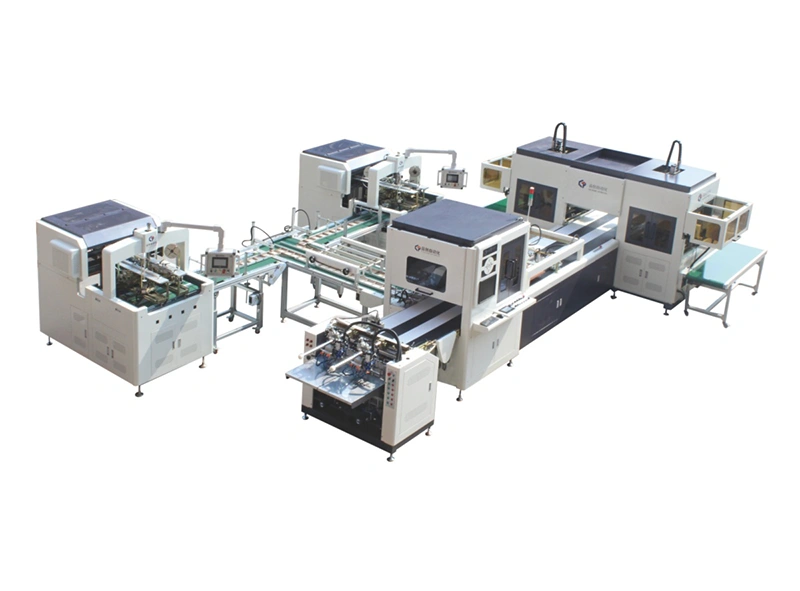
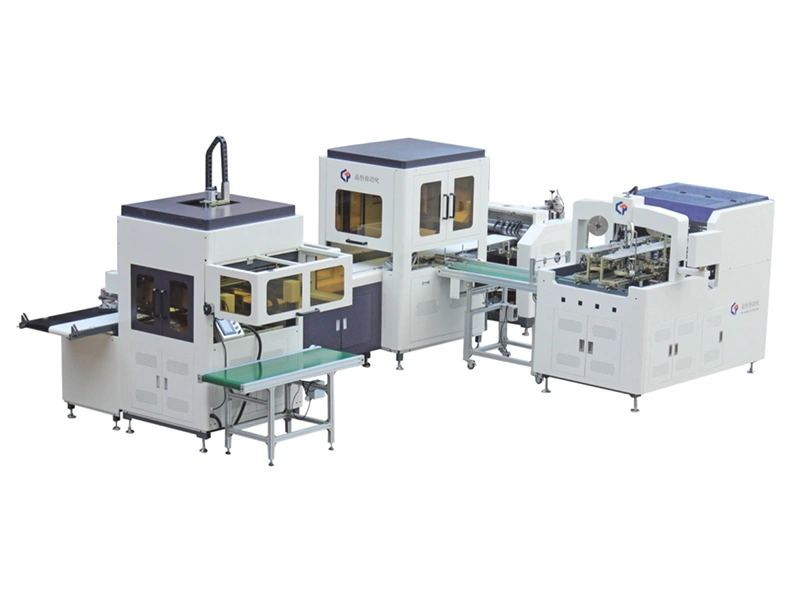
So where does stability come from? It comes from rethinking how the entire process – from board feeding to finished box ejection – is orchestrated. Instead of a mechanical line shaft tying everything together, servo-driven rigid box systems allow each station to operate on its own precise electronic cam profile. That means the wrapper doesn’t have to wait for the corner press if a board is slightly delayed; it adjusts phase on the fly. This is the principle behind modern, fully automatic box forming cells that maintain registration within ±0.2 mm even as throughput climbs past 35 boxes per minute. If you need a deeper look into how such automated systems that prioritize continuous motion over intermittent start-stop actions redefine line stability, there are dedicated platforms that map out the complete shift from mechanical to electronic synchronization.
Breaking Down the Speed-Stability Matrix
To make a smart investment decision, it helps to compare the two approaches side by side. Below is a matrix I’ve developed after visiting 14 rigid box plants across three continents. The metrics are based on real production data, not spec sheets.
| Criterion | Traditional Mechanical System | Modern Servo-Integrated System |
| Core motion principle | Single motor driving a line shaft with fixed phase relationships; clutch-brake stations. | Independent servo motors per station; electronic camming with real-time phase correction. |
| Max reliable speed (boxes/min) | 15–22 (stable), 25+ with quality degradation. | 30–40 stable; tested over 8-hour shifts. |
| Format changeover time | 45–90 minutes (mechanical adjustment, trial runs). | 10–20 minutes (recipe-driven, automatic positioning). |
| Scrap rate at top speed | 3–7% depending on board consistency. | Typically under 1.5%, thanks to optical registration and automatic reject. |
| Dependence on operator skill | High; one experienced “guru” needed per shift. | Low; recipes handle critical adjustments; operator monitors exception alerts. |
| Glue application control | Roller or basic piston pump; viscosity fluctuation causes warping. | Closed-loop servo-driven glue heads with temperature control and pattern management. |
Sources: Internal plant benchmarking (2023–2025); FEFCO Production Efficiency Report, 2024; ISO 12647-7 process control adaptations for box finishing.
What this table underscores is that speed isn’t just about faster cycles. It’s about how many good boxes you produce per shift, per day, per year. A system running at 38 boxes per minute with 1.2% scrap will yield significantly more saleable output than a system running at 30 boxes per minute with 4.5% scrap. The math is straightforward, yet many purchasing decisions are still driven by the headline number on the brochure.
Stability Beyond the Machine Frame
Stability also lives in the supply of material. Inconsistent greyboard moisture content – a common issue in regions with high humidity – can expand the board by 0.3–0.8 mm before it even hits the forming station. A truly robust system doesn’t just react to this; it anticipates it. In-line humidity sensors can feed data back to the pressing station so that dwell time and pressure are adjusted automatically, ensuring each box leaves with the same wrapping tension regardless of ambient conditions.
Another layer is glue management. The switch from hot melt to cold PVA, or vice versa, often destabilizes a line because the open time changes. Temperature-controlled glue tanks with active recirculation eliminate morning warm-up instability and maintain a constant viscosity curve. This detail alone has helped one European rigid box specialist slash their Monday morning startup scrap from 12% to under 2%, a figure they verified through a third-party audit by the German packaging institute, SLV.
If you’re exploring how to bridge the gap between your current line and that level of process control, taking a close look at a purpose-built rigid box forming solution that integrates adaptive pressing and glue management can clarify how much of this intelligence is already available on the market.
Designing a Future-Proof Investment
Box styles are multiplying. An e-commerce cosmetics brand might want a two-piece telescoping rigid box with a satin ribbon pull this season, and a flip-top magnetic closure with an EVA inlay the next. A machine that excels at single-panel boxes but struggles with clamshells will hold your business back. The best investment methodology we’ve seen among packaging converters involves building a “style portfolio matrix” – listing every box style they anticipate running over the next five years, then scoring candidate systems against that matrix.
Three criteria consistently separate future-proof lines from dead-end purchases:
-
Modular station design. Can you add a second wrapping station or an automatic magnetic sheet inserter without rebuilding the entire line? Modular platforms with CANopen or EtherCAT communication allow you to integrate new modules in days, not months.
-
Recipe-driven operations. Every adjustment – presser pressure, glue bead length, folding timing – should be stored in a digital recipe. Changing over means loading a recipe, not turning wrenches. This is particularly critical for short-run luxury packaging, where 500-box orders are common.
-
Remote diagnostics and OEE tracking. The ability to track true Overall Equipment Effectiveness (OEE) in real time and allow the machine builder to log in securely for preventive support reduces downtime by an average of 20%, according to VDMA research.
If those three elements are in place, the system is already architected for stability. To view detailed specifications and performance benchmarks that real converters are achieving with this kind of architecture, you’ll see that the numbers often surpass the theoretical outputs of legacy lines.
Where Does Human Craftsmanship Fit?
A concern I hear repeatedly is that full automation erases the craft appeal of rigid boxes. In reality, automation shifts the human touch to where it adds real value. Instead of correcting misfeeds, operators become quality auditors, material managers, and process improvers. One Scandinavian converter restructured their team: they moved their most experienced wrapper from the line to a master trainer role, and they now on-board new operators 60% faster while maintaining the subtle hand-feel knowledge that only years of experience provide.
The rigid box making machine you choose will inevitably shape your operational culture. Select one that treats your operators as knowledge workers, not button-pushers, and the stability you gain will extend far beyond the mechanical frame.
A Calmer Way Forward
James, the packaging manager we met at the start, eventually reconfigured his entire production philosophy. He didn’t simply buy a faster machine; he invested in a system that let him control speed and precision as a single, adjustable parameter. The 500,000-unit order went out two days early. More tellingly, his team now runs three shifts with half the overtime, and the night shift operates unattended for four-hour stretches, trusting the line to alert them only if something really needs attention.
If your business is feeling the tension between delivery deadlines and quality expectations, the starting point isn’t to search for a miracle machine. It’s to redefine what “stable throughput” means for your specific mix of materials, styles, and customers. Then look for a solution that delivers that stability at the speed your market demands. For a closer look at how a fully integrated system achieves this balance across different box formats and production volumes, you might want to explore Pinchuang’s high-speed rigid box production platform, designed for continuous, unattended operation.
References & Disclaimer
-
FEFCO Production Efficiency Report, 2024.
-
VDMA OEE Benchmarking Guidelines, 2023.
-
Internal plant performance data, anonymized and aggregated from 14 facilities, 2023–2025.
-
This article is for informational purposes only. Actual machine performance will vary based on material quality, maintenance practices, operator training, and facility conditions. Always request a detailed, application-specific demonstration before making a purchasing decision.