
 English
 Español
 Aug 21,2026
If you are currently assembling rigid boxes manually or with semi-automatic equipment and wondering whether to invest in a fully automatic rigid box making machine, the short answer is: it depends on your order volume, box variety, labor cost, and quality consistency requirements. There is no single "best" machine—only the machine that fits your specific production profile.
This guide walks through the key decision factors, compares automation levels, and provides a practical framework to help you choose the right rigid box making machine for your transition from manual to automated production.
Why Manufacturers Move from Manual to Automatic Rigid Box Production
Rigid boxes are widely used in premium packaging for jewelry, cosmetics, electronics, footwear, and luxury gifts. As order volumes grow and quality expectations rise, many manufacturers reach a point where manual assembly no longer meets production requirements.
Common signs that it may be time to consider automation include:
-
Inconsistent box quality — manual processes produce variable results
-
Labor shortages or high turnover — skilled manual assemblers are hard to find and retain
-
Increasing order volumes — manual lines cannot scale efficiently
-
Tight delivery schedules — production bottlenecks delay shipments
-
High material waste — manual errors lead to rejected boxes
The core question is not whether automation is "better" — it often is — but when and how much automation makes sense for your specific operation.
Understanding the Automation Levels
Before selecting a machine, it helps to understand the three main levels of rigid box production automation.
| Automation Level | Description | Typical Output | Best For |
|---|---|---|---|
| Manual | Each process step (gluing, wrapping, forming) done by hand with basic tools | Low; highly variable | Prototyping, ultra-low volume, complex custom boxes |
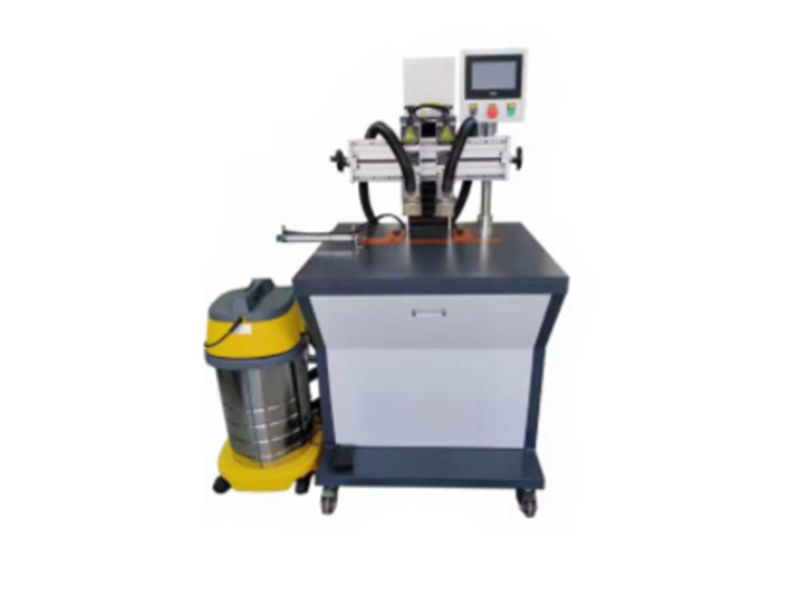
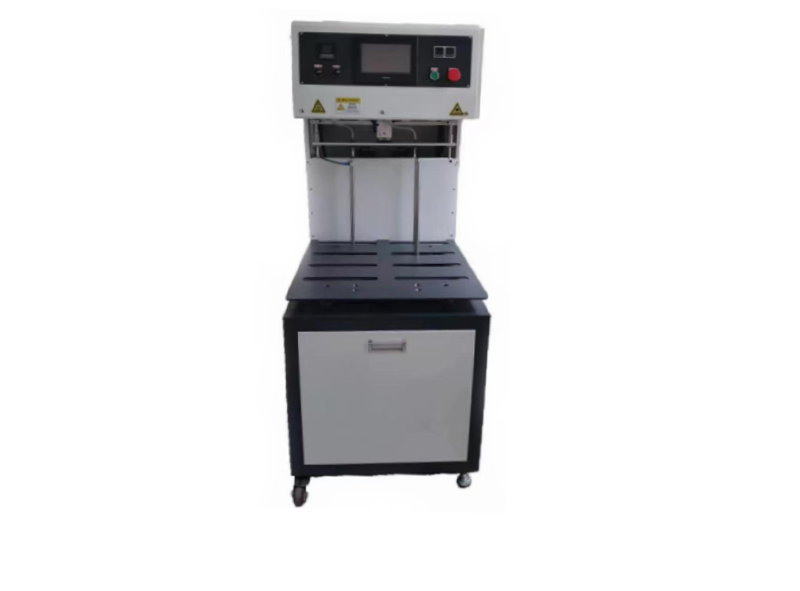
| Semi-Automatic | Individual automated machines for specific processes (e.g., corner pasting, V-grooving, forming); operators feed and transfer materials between stations | Moderate; 10–30 pcs/min depending on process | Factories starting automation gradually; mixed product lines; limited budget |
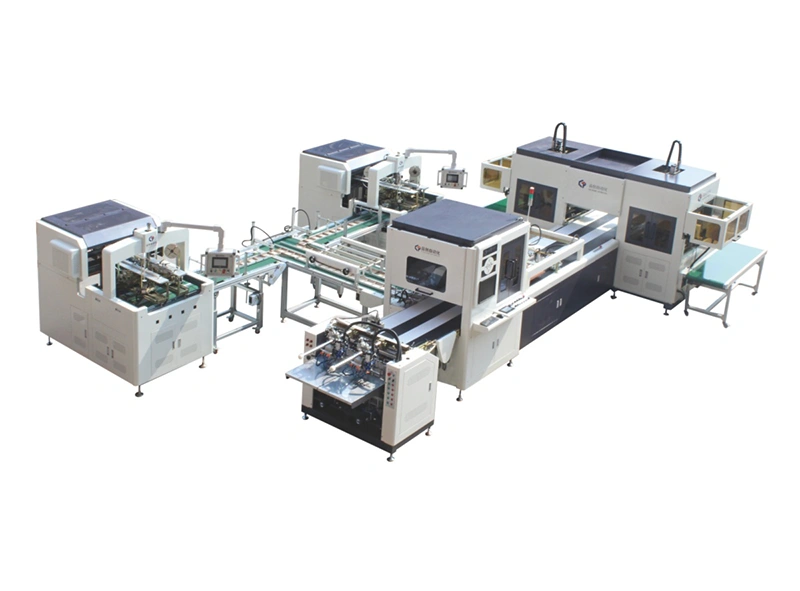
| Fully Automatic | Integrated production line from paper feeding to finished box; minimal manual intervention | High; 16–50+ pcs/min depending on model | High-volume production; consistent product specs; labor cost reduction |
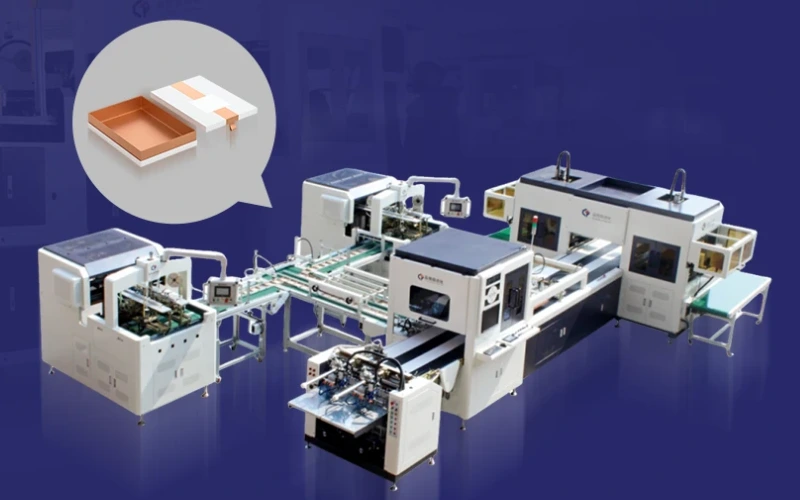
Pinchuang offers both fully automatic integrated lines and semi-automatic standalone machines, allowing customers to choose flexible integration or phased investment based on their current growth stage and budget.
Key Factors to Consider When Choosing a Rigid Box Making Machine
1. Box Size Range
Different machines are designed for different box size ranges. This is often the first filtering criterion.
-
Standard sizes (up to L500×W400×H120mm): Models like PC-5040B, PC-5040A, and PC-8040A handle this range
-
Small boxes (up to L300×W260×H100mm): PC-350B and PC-350A are optimized for small-size production
-
Minimum box size: Some models can go as small as L45×W45×H15mm
Decision rule: Match the machine's maximum and minimum box size to your current and planned product portfolio. If you produce both small jewelry boxes and larger gift boxes, ensure the machine you choose covers your full range — or consider multiple machines for different size families.
2. Production Speed Requirements
Production speed varies significantly by model and automation level.
| Model | Speed Range | Key Feature |
|---|---|---|
| PC-350B | 35–50 pcs/min | Small boxes, Mitsubishi robot, dual forming stations |
| PC-8040A | 20–44 pcs/min | Dual-station, lid and base simultaneously |
| PC-5040A | 26–40 pcs/min | High-speed servo drive |
| PC-5040B | 16–30 pcs/min | Economic entry-level |
| PC-350A | 20–35 pcs/min | Compact, Yamaha visual positioning |
Decision rule: Calculate your required daily output (orders per day × boxes per order ÷ operating hours). Choose a machine with a sustained speed at least 20% above your current requirement to allow for growth.
3. Positioning and Precision Requirements
For high-end packaging — cosmetics, jewelry, electronics — print registration accuracy is critical. Misaligned printing on the box surface directly affects brand perception.
Pinchuang offers two main positioning technologies:
-
Yamaha Visual Positioning System: Achieves ±0.1mm positioning accuracy. Uses a Yamaha robot with high-resolution cameras for precise alignment. Suitable for high-end rigid boxes and hardcover cases.
-
Photoelectric Positioning: Uses photoelectric eye sensors for position correction. Cost-effective for applications where ±0.5mm accuracy is acceptable.
Decision rule: If your boxes carry detailed print, logos, or patterns that must align perfectly with box edges or windows, visual positioning is recommended. For plain or solid-color boxes, photoelectric positioning may be sufficient.
4. Product Mix and Changeover Frequency
If you produce a wide variety of box sizes and styles with frequent changeovers, look for machines with:
-
Fast size changeover capabilities
-
One-click parameter switching
-
Quick mold change systems
For high-mix, low-volume production, semi-automatic machines or flexible fully automatic lines may be more practical than high-speed dedicated lines that require long changeover times.
5. Labor and Skill Availability
Fully automatic machines reduce labor dependency significantly. However, they require operators with basic technical skills for monitoring, troubleshooting, and maintenance.
Semi-automatic machines require more operators but lower technical skill per operator. The trade-off is between labor cost and technical capability.
Decision rule: Assess your local labor market. If skilled labor is scarce and expensive, the higher upfront cost of full automation may pay back quickly through labor savings.
6. Investment Budget and ROI Horizon
Fully automatic rigid box making machines represent a significant capital investment. Consider:
-
Initial equipment cost
-
Installation and training costs
-
Ongoing maintenance and spare parts
-
Labor savings (how many operators can be redeployed)
-
Waste reduction (automatic processes typically produce fewer rejects)
-
Increased production capacity (ability to take on more orders)
Pinchuang offers machines ranging from economic entry-level models (PC-5040B) to high-end dual-station systems (PC-8040A), allowing customers to match investment level to their current scale and growth plans.
Automation Transition Strategies
Option A: Step-by-Step Automation
Start with semi-automatic machines for key bottleneck processes, then gradually add automation as volume grows.
Advantages:
-
Lower initial investment
-
Easier for operators to adapt
-
Can prioritize the most painful manual processes first
Disadvantages:
-
May require multiple investments over time
-
Integration between semi-automatic units may be less seamless
-
Total cost over time may exceed a single fully automatic line
Option B: One-Stop Full Automation
Invest in a fully automatic integrated line from the start.
Advantages:
-
Highest efficiency and consistency
-
Single point of responsibility for the entire line
-
Lower long-term labor cost
Disadvantages:
-
Higher upfront capital requirement
-
Requires more technical capability for operation and maintenance
-
May be overkill for low or highly variable volumes
Pinchuang supports both approaches, offering fully automated integrated solutions as well as modular semi-automatic units.
Checklist: Questions to Ask Before Selecting a Rigid Box Making Machine
Use this checklist to gather the information you need before contacting suppliers:
- □
What is my current daily/weekly production volume?
- □
What is my projected volume in 1–2 years?
- □
What are the minimum and maximum box sizes I produce?
- □
What materials do I use (paper weight, cardboard thickness)?
- □
Do my boxes require precise print registration?
- □
How many different box styles/sizes do I run per week?
- □
How many operators are currently involved in box production?
- □
What is my budget range for equipment investment?
- □
What is my target payback period?
- □
Do I have technical staff who can operate and maintain automatic equipment?
- □
What after-sales support and spare parts availability does the supplier offer?
Common Mistakes to Avoid
Mistake 1: Choosing Based on Speed Alone
A high-speed machine that cannot handle your box sizes or requires frequent changeovers will not improve your actual throughput. Match the machine to your product mix, not just the maximum speed number.
Mistake 2: Underestimating Changeover Time
Some machines advertise high speeds but require hours for size changeovers. If you run small batches, changeover time may dominate your production schedule.
Mistake 3: Ignoring Material Compatibility
Different machines handle different paper weights and cardboard thicknesses. Always verify that the machine supports your materials.
Mistake 4: Overlooking Support and Spare Parts
A machine is only as reliable as the support behind it. Pinchuang provides 12-month warranty, 24/7 support, and guaranteed spare parts availability.
Frequently Asked Questions
Q1: How do I know if my factory is ready for a fully automatic rigid box machine?
A: If your monthly volume consistently exceeds what your manual or semi-automatic line can handle without overtime, and you have stable product specifications, you are likely ready. Start by calculating your current capacity vs. actual orders over a 3–6 month period.
Q2: Can I start with a semi-automatic machine and upgrade later?
A: Yes. Pinchuang offers semi-automatic standalone machines that can be integrated into a fully automatic line over time. This phased approach protects your initial investment while allowing for future expansion.
Q3: What is the difference between visual positioning and photoelectric positioning?
A: Visual positioning uses cameras and image processing for alignment, achieving ±0.1mm accuracy. Photoelectric positioning uses light sensors for edge detection, typically achieving ±0.5mm accuracy. Visual positioning is recommended for print-registration-critical applications.
Q4: What materials are compatible with automatic rigid box making machines?
A: Most machines support coated paper, art paper, cloth, and synthetic materials with paper thickness typically ranging from 80–300g/m² and cardboard thickness from 1–4mm. Always confirm your specific materials with the supplier.
Q5: How long does it take to receive a machine after ordering?
A: Delivery time varies by machine type. Semi-automatic machines typically ship within 10 working days, while fully automatic machines require 15–20 working days.
Q6: What after-sales support is included?
A: Pinchuang provides a 12-month warranty, overseas installation and training services, online guidance and troubleshooting, remote assistance for program adjustments, and guaranteed spare parts availability.
Conclusion
Moving from manual to automatic rigid box production is a significant decision that requires careful evaluation of your box sizes, volume requirements, quality standards, labor situation, and investment capacity.
The right machine is the one that matches your current needs while allowing room for future growth. There is no universal "best" machine — only the machine that fits your specific production profile.
Before making a decision, review the available configurations in the rigid box making machine product category, compare models by size and speed, and discuss your material and production requirements with the supplier to confirm specifications.
Start with your box dimensions and target output — the right machine will follow from there.