
 English
 Español
 Aug 15,2026
A dual-station rigid box line produces both the lid and base of a two-piece rigid box simultaneously within the same production cycle, rather than running them separately on a single-station machine. Whether upgrading makes sense for your facility depends primarily on three factors: daily output volume, product mix complexity, and available floor space. If your production consistently exceeds 15,000 boxes per day with stable demand, a dual-station configuration typically delivers measurable ROI. For operations with frequent format changes (more than five box sizes per shift), however, the changeover complexity of dual-station systems may offset their throughput advantages.
This article provides a practical decision framework for packaging manufacturers evaluating whether to upgrade from a single-station to a dual-station rigid box production line.
Understanding the Upgrade Decision
Before committing to a dual-station system, it helps to understand what the upgrade actually changes on your production floor.
In a single-station rigid box making machine, all forming operations occur sequentially at one location. The machine produces lids in one run, then is reconfigured to produce bases in a separate run. Cycle times typically range from 15 to 25 seconds per box, depending on format and material.
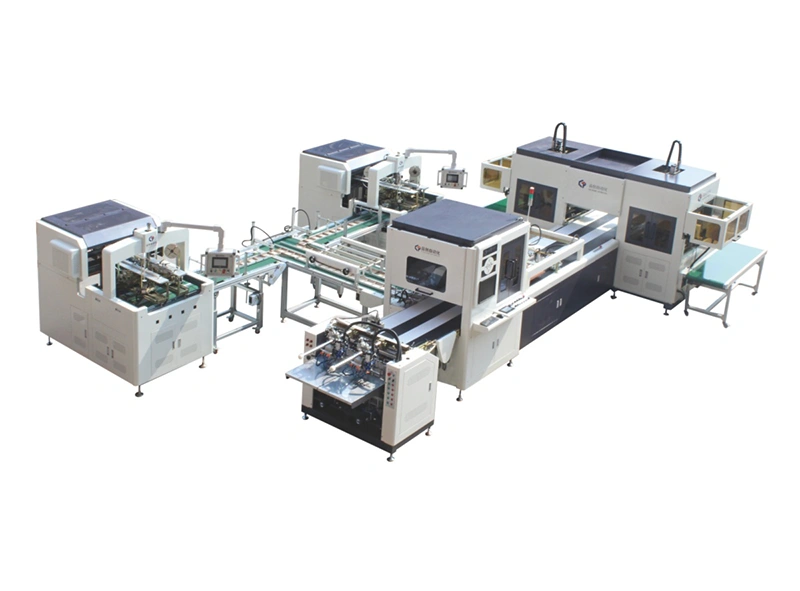
A dual-station configuration, by contrast, splits the workflow into two parallel stations. While one station forms the base, the other simultaneously forms the lid for the next box. This parallelism can cut effective cycle time to 8–14 seconds. The key technical enabler is the dual forming station architecture, which allows two forming operations to occur concurrently rather than sequentially.
However, the upgrade is not simply about buying a faster machine. It changes how you schedule production, manage changeovers, train operators, and utilize floor space.
When Does Upgrading Make Sense?
Not every production environment benefits from a dual-station upgrade. Understanding your specific operating conditions is essential.
1. Daily Output Volume
Single-station systems typically suffice for operations running 5,000–10,000 boxes per day.
Dual-station systems start to make economic sense when production consistently exceeds 15,000 boxes per day with relatively stable demand.
The logic is straightforward: the throughput advantage of parallel processing only delivers value if upstream material feeding and downstream packing can sustain the higher output rate. If your board feeding or stacking units cannot keep pace, the dual-station's extra capacity sits idle.
2. Product Mix and Changeover Frequency
This is where the decision becomes more nuanced.
| Production Scenario | Recommended Configuration | Reason |
|---|---|---|
| High volume, low mix (1–3 box formats) | Dual-station | Changeovers are infrequent; throughput advantage dominates |
| Medium volume, medium mix (4–5 formats) | Depends on batch sizes | Evaluate changeover time vs. throughput gain |
| Low volume, high mix (6+ formats per shift) | Single-station or dual-head with quick-change tooling | Changeover complexity can offset throughput gains |
Single-station systems offer a clear advantage for facilities handling more than five box formats per shift. With all tooling located in one position, a skilled operator can complete a full size change in 10–15 minutes. Dual-station systems require synchronized adjustments across two stations, extending changeover time.
However, modern dual-head architectures address this challenge by allowing one station to produce while the other is being set up for the next format. This parallel operation effectively turns changeover time from a line-stopping event into a background task.
3. Floor Space and Line Layout
A common misconception is that a dual-station machine is twice as long as a single-station unit. In practice, it is typically only 30–50% larger because stations share frames, control systems, and safety guarding.
The real footprint consideration involves auxiliary equipment. Dual-station configurations demand more sophisticated board infeeds and higher-capacity stacking units. When configured for dual stations, total line length can stretch by 3–5 meters compared to a standalone single-station work cell.
4. Box Size Requirements
The physical dimensions of your boxes also influence the upgrade decision.
| Box Size Category | Typical Application | Recommended Approach |
|---|---|---|
| Small (≤ L300×W260×H100mm) | Jewelry, watches, cosmetics, small gifts | Dual-station viable; PC-350B class systems achieve 35–50 pcs/min |
| Standard (≤ L500×W400×H120mm) | Gift boxes, electronics, medium luxury | Dual-station available; standard-size systems operate at 26–40 pcs/min |
| Large (> L500×W400×H120mm) | Specialty packaging | Check with supplier; may require custom configuration |
High-end dual-station systems incorporate robotic arms and vision systems to maintain positioning accuracy, with typical precision reaching ±0.1 mm.
Key Technical Considerations for the Upgrade
Dual-Station Workflow Overview
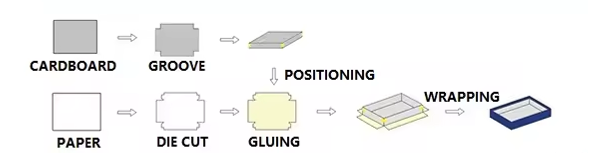
A dual-station rigid box forming machine typically operates through the following workflow:
-
Material feeding — Paper and cardboard are fed into two separate forming stations
-
Gluing and positioning — Each station applies adhesive and positions materials for forming
-
Simultaneous forming — Both stations form their respective components (lid and base) in parallel
-
Vision positioning — Systems such as Yamaha vision positioning guide component assembly for precision
-
Output — Completed lids and bases exit the machine at matched production rates
The production speed varies by machine configuration and box size. Dual-station systems typically operate at speeds ranging from 20 to 44 pieces per minute, depending on box dimensions and material characteristics.
What to Verify Before Upgrading
Before making the investment decision, consider the following verification checklist:
- Current production data: Document your average daily output, peak demand periods, and typical batch sizes over the past 12 months
- Product mix analysis: List all box formats you currently produce, including dimensions, materials, and frequency
- Changeover logs: Record actual changeover times for your current equipment, including setup, trial runs, and adjustments
- Bottleneck identification: Identify whether the bottleneck is forming speed, material feeding, or downstream packing
- Operator capability: Assess whether your team has the technical skills to manage dual-station synchronization
- Floor space audit: Measure available space including material staging, machine footprint, and finished goods handling
- Future demand forecast: Project your production requirements for the next 2–3 years
Common Misconceptions About Dual-Station Upgrades
Misconception 1: “Dual-station means double the output.”
The throughput gain depends on your specific production mix. If you primarily produce lids and bases in matched quantities, the parallel processing delivers near-double output. But if your orders are lid-heavy or base-heavy, the advantage diminishes.
Misconception 2: “Dual-station systems are harder to operate.”
While dual-station systems require more sophisticated setup procedures, modern systems with recipe management store hundreds of format parameters—feeder height, wrapping paper tension, corner folding dimensions—and recall them per SKU. Servo-driven axes reset automatically, removing much of the guesswork and inconsistency of manual adjustments.
Misconception 3: “Upgrading means replacing everything.”
Some manufacturers can upgrade incrementally. Semi-automatic units allow you to automate step by step, protecting your investment while boosting efficiency. Review the available configurations to understand what fits your current growth stage and budget.
Cost Factors to Consider
While specific pricing varies by configuration, the following cost categories should be evaluated:
| Cost Category | What to Consider |
|---|---|
| Capital equipment | Base machine cost plus optional features (vision systems, robotics, custom tooling) |
| Installation | Delivery, positioning, connection to utilities |
| Training | Operator and maintenance training for the new system |
| Auxiliary equipment | Upgraded infeeds, stacking units, material handling |
| Spare parts inventory | Additional parts for the second station |
| Maintenance | Potential increase in preventive maintenance requirements |
| Floor space | Opportunity cost of the additional footprint |
Actual performance depends on operating conditions, material characteristics, and production setup. Buyers should confirm specifications with the supplier based on their specific requirements.
Decision Summary: Single-Station vs. Dual-Station
| Factor | Stick with Single-Station | Consider Dual-Station Upgrade |
|---|---|---|
| Daily output | Below 10,000 boxes | Above 15,000 boxes |
| Product mix | 5+ formats per shift | 1–3 formats per shift |
| Changeover frequency | Frequent (multiple times per shift) | Infrequent (daily or less) |
| Available floor space | Limited | Adequate for 3–5m longer line |
| Box size | Variable, includes large formats | Consistent, small to medium |
| Investment horizon | Short-term (< 2 years) | Long-term (3+ years) |
FAQ
Q: What is the main difference between single-station and dual-station rigid box machines?
A: A single-station machine performs all operations sequentially at one location, producing lids and bases in separate runs. A dual-station system has two forming stations that produce both components simultaneously in parallel, reducing cycle time from 15–25 seconds to 8–14 seconds per box.
Q: How do I know if my production volume justifies a dual-station upgrade?
A: If your facility consistently produces more than 15,000 boxes per day with relatively stable demand, a dual-station configuration typically delivers measurable ROI. Operations running 5,000–10,000 boxes per day usually find single-station systems sufficient.
Q: Does a dual-station machine take up twice the floor space?
A: No. A dual-station machine is typically only 30–50% larger than a single-station unit because stations share frames, control systems, and safety guarding. However, the total line may extend by 3–5 meters when including upgraded infeeds and stacking units.
Q: Can I upgrade gradually from single-station to dual-station?
A: Yes. Semi-automatic modular units allow you to automate key processes step by step. This phased approach can protect your investment while you build volume. Discuss your specific upgrade path with the equipment supplier.
Q: What precision can I expect from a dual-station system?
A: High-end dual-station systems incorporate vision positioning (such as Yamaha systems) that achieve positioning accuracy of ±0.1 mm. This precision ensures that lids and bases fit together consistently, reducing quality rejects.
Q: Are dual-station systems suitable for small box production?
A: Yes. Models like the PC-350B are specifically optimized for small boxes (up to L300×W260×H100mm) and achieve production speeds of 35–50 pcs/min with dual forming stations.
Conclusion
Upgrading from a single-station to a dual-station rigid box line is not a decision to make lightly. The right choice depends on your production volume, product mix, floor space, and long-term capacity plans.
The key takeaway: If you consistently produce over 15,000 boxes per day with a stable product mix, dual-station economics are compelling. If your operation handles frequent changeovers with smaller batch sizes, evaluate whether modern dual-head architectures with quick-change capabilities can address your specific challenges.
Before making a decision, verify your assumptions with actual production data. Review the available rigid box making machine configurations to understand which options align with your production requirements. Discuss your material and production requirements with the supplier to confirm technical specifications.