
 English
 Español
 Jun 16,2026
It’s 8:15 AM on a Monday, and the floor manager at a luxury packaging facility is staring at the day’s dispatch list. Three hot orders: a 500-piece magnetic closure gift box, 300 drawer-style watch boxes, and a 200-unit book-wrap box—all in different sizes, all with separate wrapping paper and interior fitments. On a conventional single-head line, changeover between these formats would eat up nearly two hours, not counting trial runs and glue adjustments. Overtime costs spiral, and delivery windows shrink.
For packaging converters navigating this high-mix reality, the question isn’t whether they can handle variety, but how to do so profitably. The answer increasingly points away from incremental fixes and toward a fundamentally different production architecture. Discover how a flexible dual-head rigid box line can transform your changeover workflow.
The Real Cost of High-Mix, Low-Volume Production
Many box manufacturers underestimate the hidden drain of frequent changeovers. Beyond direct labor, every minute spent on setting feeder angles, swapping forming dies, and calibrating glue patterns is lost capacity. Industry surveys reveal that typical rigid box plants lose 15–20% of productive time to format transitions, with some high-mix runs pushing that figure past 30%. Quality also suffers: first-off rejects climb when settings are dialed in under time pressure, eroding margins on already tight batches.
The root of this inefficiency is sequential processing. A conventional rigid box making machine is designed to do one thing well—repeat the same box format thousands of times. When you force it to switch contexts frequently, its downtime multiplies. Operators become the bottleneck, and the machine’s high speed only highlights the idle intervals in between.
Why Dual-Head Architecture Changes the Game
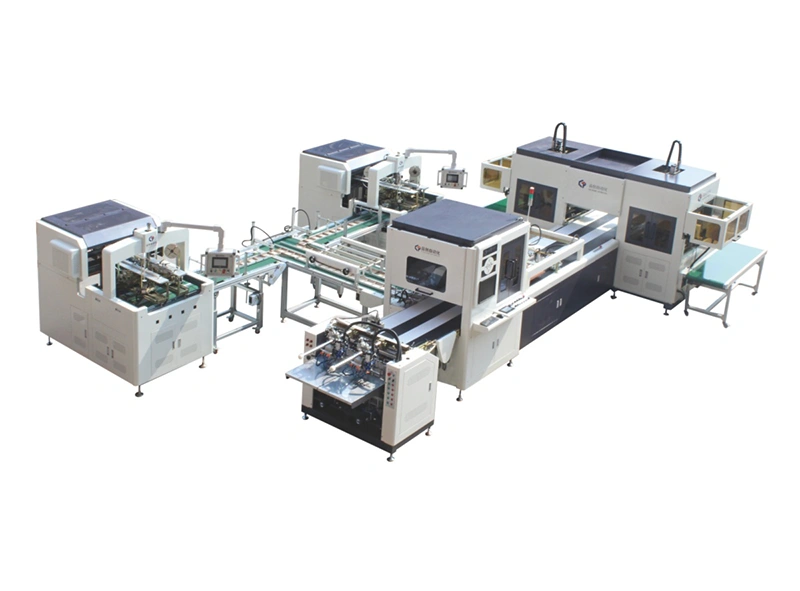
A dual-head rigid box line tackles the problem by splitting the process into two independently operated stations. Think of it as parallel processing for packaging: while Station A is producing the current order, Station B can be fully offline for the next format’s die change, feeder setup, and glue system purge. Once Station A finishes, production shifts instantly to Station B with a tap on the HMI—no ramp-up, no trial-and-error alignment. The cycle then repeats.
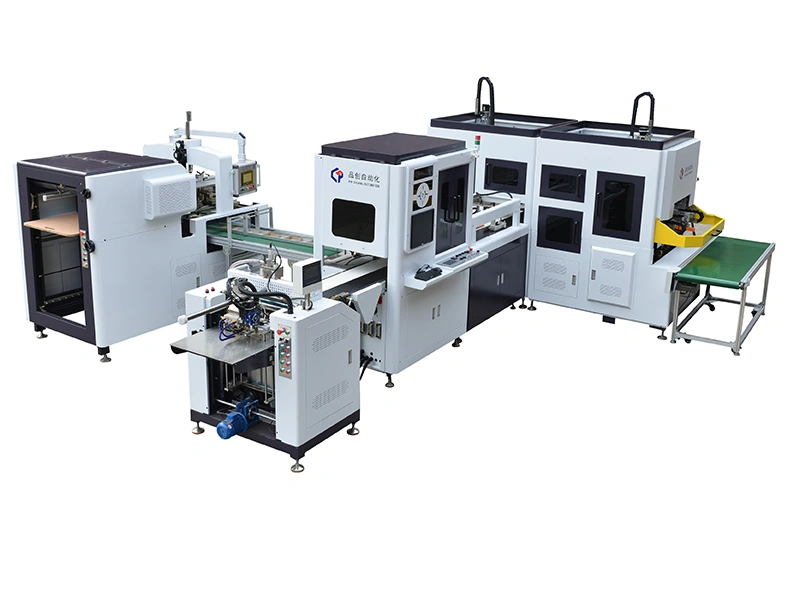
This parallel operation turns changeover time from a line-stopping event into a background task. It effectively uncouples setup complexity from throughput. When you handle short runs that might last only 20 minutes of actual production, the ability to eliminate even 15 minutes of traditional changeover can double your output. See how this automated box forming system achieves sub-5-minute switches.
A Closer Look at the Dual-Head Advantage
Here’s where the real engineering depth surfaces. A well-designed dual-head line isn’t simply two single heads bolted together. It integrates smart recipe management that stores hundreds of format parameters—feeder height, wrapping paper tension, corner folding dimensions, glue temperature—and recalls them per SKU. Servo-driven axes reset automatically, removing the guesswork and inconsistency of manual adjustments. Unlike a standard rigid box making machine, where a single missing memory setting can lead to wrinkled corners on the first 50 boxes, the dual-head platform treats recipes as loadable scripts, validated by the last successful batch.
The result is operational agility that was once reserved for soft-packaging converters. A cosmetics packaging supplier, for instance, can now run a sequential mix of lipstick boxes, fragrance sets, and advent calendars within a single shift, each with completely different footprints, without a single line stoppage. Their OEE metrics shifted from the mid-50s to above 80%.
Choosing the Right Configuration: Single vs. Dual Head
To clarify the decision, let’s break down how single-head and dual-head architectures compare in a high-mix environment.
| Criteria | Single-Head Rigid Box Line | Dual-Head Rigid Box Line |
| Changeover Time per Format | 15–30 minutes (sequential) | <5 minutes (offline parallel) |
| Mixed-Order Throughput | Limited by cumulative downtime | Near-continuous; downtime hidden |
| Operator Skill Dependency | High – manual setup nuances | Low – recipe-driven, guided tasks |
| Waste on First-off | Can be 5–10% of short-run batch | Typically <1% after recipe recall |
| Scalability for High-Mix | Requires dedicated lines per format | One line handles dozens of formats |
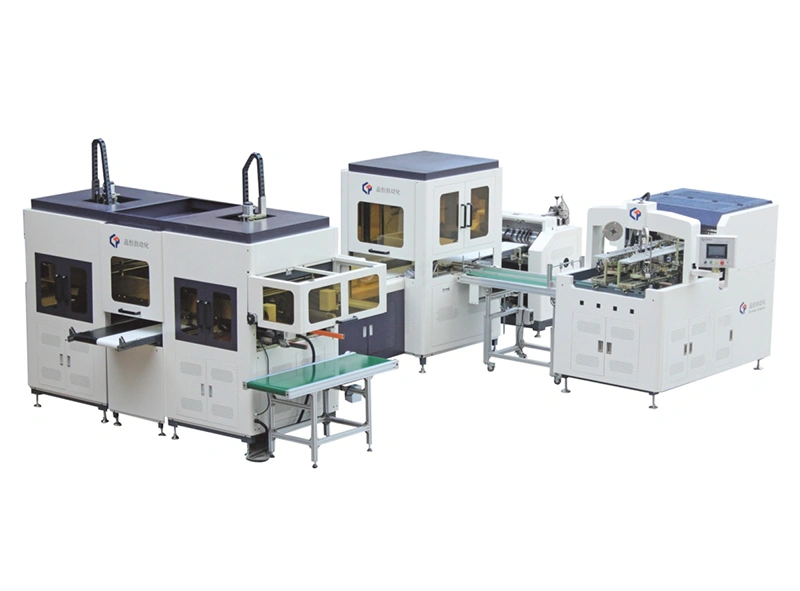
When high-mix jobs account for more than 40% of your order book, the dual-head design stops being a luxury and becomes a capacity-preserving strategy. Instead of buying a second single-head line to catch overflow, you make one intelligent line do the work of two.
Making the move, however, requires looking beyond the hardware. An equipment platform for mixed box styles must also be supported by quick-change tooling interfaces (e.g., pneumatic clamps, magnetic platens) and material handling that can feed varied sheet sizes without manual intervention. Pinchuang, for example, engineers its dual-head platforms with modular in-feeds and integrated vision systems that verify sheet orientation, preventing misfeeds that used to plague multi-format production.
Integrating the Line into a Smart Factory
A dual-head rigid box line doesn’t exist in a vacuum. To extract its full value, you need a digital backbone. Recipe data should sync with your MES or ERP, allowing automatic scheduling that groups similar materials to minimize cleaning cycles. IoT sensors on glue application and pressing stations can feed real-time SPC data, flagging drift before it creates defects. This turns the line into a self-correcting asset rather than a constant firefight.
From a compliance and reliability standpoint, look for suppliers whose designs adhere to CE and ISO 13849 safety standards, and who can provide traceable validation reports for adhesive bonding strength according to ASTM D903. Real-world case studies with verifiable numbers—like a 38% increase in output for a confectionery box maker after adopting dual-head technology—carry more weight than glossy brochures.
Making the Switch Without Disrupting Current Production
Retrofitting a factory doesn’t have to mean a complete shutdown. Many converters phase in a dual-head line alongside existing equipment, initially shifting their most changeover-heavy SKUs to the new line while leaving high-volume runners on legacy single-head machines. This hybrid approach builds operator confidence and generates quick ROI proof points.
That’s where working with an automation partner who understands the nuances of rigid box assembly becomes critical. Pinchuang’s engineering team has rethought every aspect of the rigid box making machine to accommodate high-mix demands—from the control architecture that makes recipe changes effortless to the ergonomic design that reduces physical strain on operators. If you’re ready to move beyond incremental efficiency tweaks, explore Pinchuang’s dual-head rigid box solution and discover how their clients have turned changeover chaos into a predictable, profitable workflow.
Disclaimer: Performance figures mentioned are based on customer-reported data and may vary depending on box size, material, and operating conditions. Always conduct a thorough on-site capacity analysis.