
 English
 Español
 May 12,2026
Picture a premium smartphone unboxing. The satisfying friction of a thick, wrapped lid lifting slowly from its base. That deliberate, silent pause before the product reveals itself? That’s a rigid box at work — and behind it stands an entire production discipline most packaging newcomers only half-understand. If you are stepping into rigid box manufacturing, whether to expand a commercial print shop or to launch a luxury packaging brand, the first concept you need to grasp is not a single gadget but a coordinated sequence: the rigid box line.
Early in my packaging career, I visited a mid‑sized converter that had just landed a contract for 20,000 magnetic‑closure gift boxes. Their floor was a maze of standalone machines: a corner‑staying unit here, a manual wrapping jig there, half‑finished trays stacked on pallets, waiting. By day three, the glue had dried prematurely on two full pallets because the wrapping station couldn’t keep pace. The lesson was brutal and universal: single‑station processing creates queues, and queues devour margin. A properly designed line turns discrete steps into a continuous flow — and that’s what we’re going to unpack here, step by step.
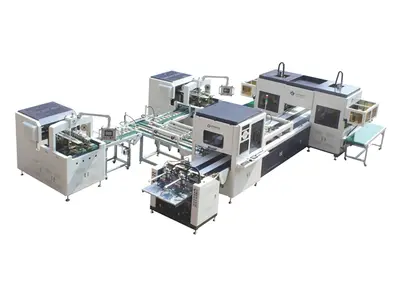
What Exactly Is a Rigid Box Line?
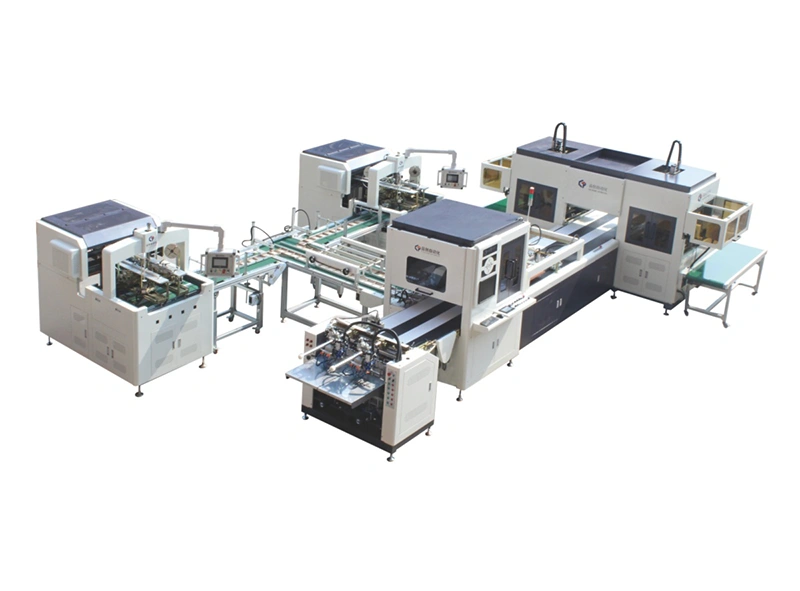
A rigid box line isn’t one machine. It’s a sequence of linked — or deliberately positioned — stations that transform flat greyboard and printed wrap into a finished, hard‑covered box. Think of it as a miniature assembly plant moving material from raw sheet to a press‑ready, precisely wrapped casing. The line typically handles board feeding, gluing, wrapping, folding, and pressing, with optional modules for magnetic‑closure insertion or inner‑tray forming. Understanding the line as a system rather than a collection of standalone devices is the first mental shift that separates a frustrated beginner from a reliable production manager.
This shift matters commercially. According to the 2023 Smithers report on luxury packaging, rigid boxes remain the dominant format for high‑end spirits, cosmetics, and consumer electronics, growing at roughly 4.1% CAGR globally. Simultaneously, lead times are shrinking. A well‑balanced rigid box line can turn an order around in days, while a fragmented setup often takes triple the time and produces significantly more waste.
Why Beginners Often Underestimate Production Flow
The most common pitfall I hear from first‑time buyers goes like this: “I’ll start with a wrapping machine and add the rest later.” On paper, it sounds frugal. In practice, it creates a bottleneck the moment your biggest client asks for a repeat order in half the time.
The problem is rooted in the nature of rigid box assembly. A typical luxury box requires:
-
precisely cut greyboard (often 1200–2000 g/m²) with grooved, fold‑ready hinges
-
a hot‑melt or cold‑glue application that must remain open just long enough for wrap positioning
-
simultaneous tensioning of the cover material across the board surface to avoid bubbles
-
a pressing stage that holds the formed box under pressure until the bond sets
If one stage runs at 25 pieces per minute and the next at 15, the pile‑up is physical and unavoidable. Many newcomers forget that throughput is defined by the slowest station, not the fastest. A cohesive line balances those speeds, either through synchronized servo drives or through intelligent buffer zones that decouple stations without human intervention.
The Core Modules You’ll Encounter
Here, we’ll walk through the typical building blocks, using language you’ll hear on factory floors. No single setup looks identical, but the logic is remarkably stable across suppliers.
Board Feeding & Positioning
Raw greyboard enters the line, often via a friction feeder or suction‑cup loader, and is placed onto a conveyor or a rotary table. The feeding mechanism compensates for board warpage — a fact of life in humid climates — by incorporating an alignment station that squares the board before any glue touches it. Flash detection sensors reject sheets with chipped corners, preventing a cascade defect downstream.
Gluing Units That Adapt to Material
Hot‑melt slot coaters remain common for their fast tack, but a growing number of lines include dual‑function heads that can switch to water‑based cold glue for specialty wraps (think textured paper, linen, or PET‑laminated sheets). The best advice I can give someone new to this space: watch how the system handles glue changeover, not just how it applies glue. According to data from The Adhesive & Sealant Council, downtime linked to adhesive clean‑up can account for up to 12% of unscheduled stops in packaging plants.
The Wrapping & Folding Station
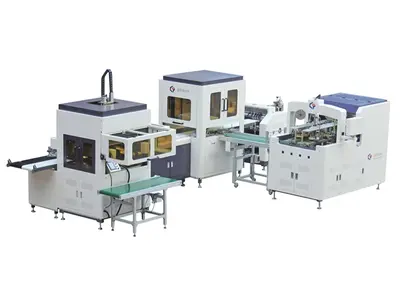
This is the heart of the line. A combination of pneumatic cylinders, cams, and folding fingers wraps the decorative sheet around the greyboard, tucking corners at 90‑degree precision. The wrap‑up sequence must contend with two contradictory demands: speed and accuracy. Many operations now rely on optical sensors and pressure feedback instead of fixed mechanical stops, allowing a single line to run formats from a slim watch box up to a deep spirits carton without manual recalibration.
Pressing & Curing Section
After folding, semi‑finished boxes pass through a pressing zone — sometimes a platen press, sometimes a rotary pressure belt. The pressing time, often 20–40 seconds at 0.2–0.4 MPa, depends on the glue chemistry. I’ve seen converters lose entire batches because they rushed the curing cycle and the wrap lifted at the edges. If your line doesn’t have adjustable pressing dwell, you’re gambling with the most visible part of the box.
Optional Modules for Added Value
Many lines now integrate a magnet insertion unit, a window‑patching station, or an inner tray former. These additions can turn a standard gift box into a premium multi‑layer unboxing experience — but they also lengthen the line and shift the bottleneck point. For a beginner, the rule of thumb is clear: master the basic flow first, automate the add‑ons only when your order mix consistently demands them.
Evaluating a Line Without Losing the Plot
With so many technical parameters floating around, it’s tempting to focus on brochure speed numbers. Here’s what a more grounded evaluation looks like, drawn from side‑by‑side observations at several packaging plants.
| Criterion | What Beginners Often Ask | The Question They Should Ask |
| Speed | “How many boxes per minute?” | “What’s the sustained rate over an 8‑hour shift including changeovers?” |
| Format range | “Can it run my current box?” | “What’s the actual changeover time between formats A and B?” |
| Precision | “What’s the stated tolerance?” | “Can I see a Cpk report from a recent customer run?” |
| Glue system | “Hot melt or cold?” | “How many glue guns are easily accessible for cleaning per shift?” |
| Service | “What’s the warranty?” | “Do you have a local technician, and what’s the average response time?” |
The Cpk (process capability index) point deserves emphasis. A machine builder that can provide a Cpk value greater than 1.33 for critical dimensions (lid‑base overhang, corner sharpness) is demonstrating that the equipment performs consistently within specification — not just during a factory acceptance test. This is a direct indicator of what packaging end‑customers will actually experience.
Common Operational Missteps Beginners Make
-
Ignoring board humidity conditioning. Greyboard is hygroscopic. If you bring skids from a cold warehouse straight onto the line in summer, dimensional shifts can exceed 0.8 mm — enough to ruin corner alignment. A 24‑hour acclimatization step costs nothing and saves hours.
-
Treating all wrap materials identically. Laminated wraps reflect heat differently and require slower hot‑melt open times. Fabric‑covered wraps often need a lower compression pressure to avoid embossing the glue pattern through the material. I’ve seen a prominent European converter reject 15% of a branded cosmetics batch simply because the line parameter wasn’t adjusted for a new matte‑coated wrap.
-
Under‑investing in operator training. A modern rigid box line may contain 12+ servo axes. Without basic troubleshooting knowledge, operators will call maintenance for errors that a simple sensor wipe could fix. One Indian packaging firm told me that after two days of structured, hands‑on training, their line utilization jumped from 71% to 88%.
If the idea of managing this many moving parts feels overwhelming, you are not alone. Many converters start with a simpler manual‑fed setup and then grow into full automation. But the data increasingly favors those who move earlier to an integrated approach — especially when labor availability is tight. To see how a modular design can simplify the transition from semi‑manual to fully automatic, you can explore this modular system’s configuration options.
How Automation Is Reshaping the Rigid Box Floor
Even for small manufacturers, three trends are quietly reshaping what a rigid box line looks like:
-
Servo‑driven flexibility. Mechanical cams are giving way to programmable servo motions, letting one line produce a watch box in the morning and a rectangular shoe box in the afternoon with minimal changeover.
-
In‑line quality vision. Cameras placed after the wrapping and pressing stations now flag box defects — skew, lifted corners, glue smears — before value is added downstream. This reduces rework and protects the brand reputation of your client.
-
Remote diagnostics. Secure IoT gateways allow equipment suppliers to perform predictive maintenance, often spotting a degrading pneumatic seal before it leaks and shuts down production.
These are not fringe experiments. Smithers’ data shows that around 35% of newly installed luxury box lines in Western Europe now include at least one in‑line vision module, up from under 10% five years ago. The return on investment comes not from eliminating labor alone but from eliminating the reputational cost of defective boxes reaching luxury brand clients.
So, What Should You Do Next?
If you are evaluating your first rigid box line, the priority is not maximum speed. It is producing defect‑free boxes with a repeatable, documented process that your client can audit. Start by running your three most frequent box formats through the candidate line — not just one demo box. Watch the changeover, not just the steady‑state production. Collect the Cpk data, and talk to operators, not just the sales engineer.
After you have that operational frame, equipment selection becomes far simpler. The line’s mechanical structure, the glue system’s maintainability, the control interface’s user‑friendliness — these become visible instead of being concealed behind glossy feature lists. For packaging shops that plan to add magnetic‑closure or multi‑piece hinged lid boxes within the next 18 months, looking for a platform that supports field‑installable modules saves capital in the long run. Learn more about how PINCHUANG approaches modular rigid box production.
Rigid boxes are tactile promises. The line that makes them needs to keep that promise, consistently, shift after shift. That begins with seeing the process as a unified whole, not a parts catalog.