
 English
 Español
 Sep 04,2026
When evaluating rigid box making machines, you will often see a specification labeled "positioning accuracy" or "position precision" with a value like ±0.1mm. This number is not just a marketing figure — it directly determines whether your finished boxes fit together properly, look premium, and pass quality inspection. In rigid box production, ±0.1mm is the threshold between consistent, high-quality output and frequent rejects, rework, and customer complaints.
This article explains what ±0.1mm positioning accuracy actually means in the context of rigid box forming, why it matters for your production, and how it affects everything from box fit to changeover time.
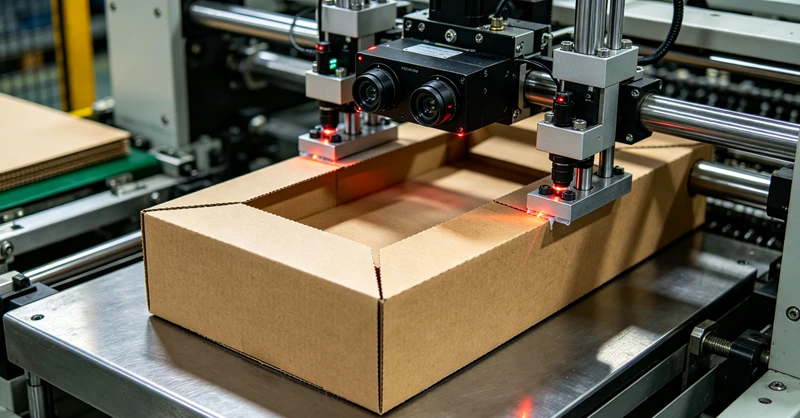
What Does ±0.1mm Positioning Accuracy Mean?
Positioning accuracy refers to the maximum deviation between where a machine component (such as a robot arm or forming station) is instructed to move and where it actually ends up. In a rigid box making machine, this applies to:
-
Cardboard placement — positioning greyboard or paperboard onto the forming station
-
Component alignment — aligning the lid and base, or positioning wrapped paper onto the board
-
Forming station movement — the precision with which forming molds close and shape the box
A specification of ±0.1mm means the machine can consistently position materials and components within a tolerance of one-tenth of a millimeter. For context, a human hair is approximately 0.06–0.08mm thick.
This level of precision is achieved through technologies such as Yamaha visual positioning systems, which use high-resolution cameras and robotic arms to guide material placement with exceptional accuracy.
Why Precision Matters in Rigid Box Production
Rigid boxes — also known as set-up boxes — are used for premium packaging in industries such as jewelry, cosmetics, electronics, and luxury gifts. Unlike folding cartons, rigid boxes are made from thick greyboard and wrapped with decorative paper, creating a sturdy, high-end feel. Because these boxes are often hand-assembled or visually inspected, even small deviations become noticeable.
1. Box Fit: Lid and Base Must Match
Rigid boxes typically consist of a separate lid and base. If the lid is even slightly larger or smaller than the base due to positioning errors, the box will feel loose, tight, or misaligned. A ±0.1mm tolerance ensures that:
-
The lid fits snugly over the base without excessive friction
-
The box closes cleanly with consistent gaps on all sides
-
Multiple boxes from the same production run are dimensionally consistent
Without this precision, you risk producing boxes that do not close properly — a common quality issue in rigid box production that leads to customer returns and brand damage.
2. Visual Alignment for Premium Aesthetics
Luxury packaging relies on visual perfection. Decorative paper must align precisely with the edges of the greyboard. Print registration — where printed graphics must match the physical box structure — requires accurate positioning. A deviation of ±0.1mm versus ±0.5mm can mean the difference between:
-
A box where printed elements are centered versus visibly shifted
-
Wrapped paper that aligns with box edges versus paper that overhangs or falls short
-
Consistent corner appearance across all boxes from a production run
Products like mobile phone boxes, cosmetic boxes, and jewelry boxes demand this level of visual consistency. Brands using rigid packaging for premium products simply will not accept visible misalignment.
3. Forming Quality and Structural Integrity
During the forming process, the machine wraps paper around the greyboard and presses it into shape. If the positioning is inaccurate:
-
Paper may wrinkle or tear during wrapping
-
Corners may not form cleanly
-
Glue application may miss the intended area, leading to weak bonds or glue stains
Over time, inconsistent forming also reduces the structural integrity of the box, affecting its ability to protect the product inside.
4. Production Yield and Waste Reduction
Every rejected box represents wasted material, labor, and machine time. In high-volume production, even a small increase in reject rate has a significant cost impact. Precision positioning helps maintain a consistent quality level across long production runs, reducing the number of boxes that fail inspection.
When machines operate at speeds of 20–44 boxes per minute (as seen on models like the PC-8040A), even a 1% improvement in yield translates to thousands of additional good boxes per shift.
5. Faster Changeovers and Less Adjustment Time
One of the overlooked benefits of high positioning accuracy is faster changeover between different box sizes. When a machine can consistently position materials within ±0.1mm, operators spend less time manually adjusting and calibrating the system after a size change.
This is particularly valuable for manufacturers handling high-mix, low-volume orders, where frequent changeovers are a production reality. Machines equipped with visual positioning systems can recall parameters for different box sizes and automatically adjust, reducing downtime.
How Positioning Accuracy Is Achieved
| Technology | Function | Contribution to Accuracy |
| Yamaha Visual Positioning | High-resolution camera detects material position; robot arm makes real-time adjustments | Enables ±0.1mm placement accuracy |
| Servo Drive Systems | Precise motor control for all moving components | Provides consistent, repeatable motion |
| Photoelectric Detection | Sensors verify material position before forming | Ensures correct alignment before critical operations |
| Full Servo Control | All machine axes are servo-driven for coordinated motion | Reduces mechanical variation across the entire process |
When ±0.1mm Is Non-Negotiable
Not all rigid box applications require ±0.1mm precision. However, you should prioritize this level of accuracy if your production involves:
-
Small boxes — where deviations are more visually apparent relative to box size
-
Printed boxes — where graphics must align precisely with box edges
-
Lid-and-base sets — where fit between the two components is critical
-
High-volume production — where consistency across thousands of units is required
-
Premium or luxury packaging — where visual perfection is expected
For example, the PC-350B model is specifically designed for small boxes with minimum dimensions of L45×W45×H15mm and achieves speeds of 35–50 pcs/min. At this scale, positioning accuracy is essential — a 0.5mm deviation on a 45mm box represents more than 1% of the total dimension.
Common Misconceptions About Positioning Accuracy
"All machines claim high accuracy — it doesn't really matter."
In reality, the difference between ±0.1mm and ±0.5mm is visible to the naked eye and noticeable in how the box feels. The accuracy specification reflects the machine's design and component quality — machines that consistently achieve ±0.1mm use higher-quality motion control systems and vision guidance.
"We can just adjust during setup."
Manual adjustment cannot compensate for inconsistent machine positioning during high-speed operation. If the machine cannot position materials accurately by itself, operators will spend excessive time on setup and still face variation during the run.
"Higher accuracy means slower production."
Modern servo-driven machines with visual positioning achieve ±0.1mm accuracy while operating at speeds of 20–44 boxes per minute or higher. Accuracy and speed are not mutually exclusive when the machine is properly engineered.
Checklist: Evaluating Positioning Accuracy in a Rigid Box Machine
When comparing rigid box making machines, use this checklist to assess positioning accuracy:
- Is the accuracy specification clearly stated? Look for "positioning accuracy," "position precision," or similar terms in the technical specifications.
- What technology achieves the accuracy? Visual positioning (Yamaha, Mitsubishi) and full servo systems are indicators of genuine precision capability.
- Is the accuracy verified during production? Ask whether the manufacturer tests accuracy with actual materials, not just on empty machine cycles.
- Does the machine maintain accuracy at speed? Verify that the stated accuracy applies at full production speed, not just during slow setup mode.
- How does the machine handle size changeovers? Machines with parameter recall and automatic adjustment reduce the risk of accuracy loss after changeovers.
- What quality control processes are in place? In-house manufacturing and systematic quality assurance contribute to consistent accuracy.
Frequently Asked Questions
Is ±0.1mm positioning accuracy necessary for all rigid box types?
No. The required accuracy depends on your application. For large, plain rigid boxes with no printed graphics, a slightly wider tolerance may be acceptable. However, for small boxes, printed boxes, or lid-and-base sets, ±0.1mm is recommended to ensure fit and appearance. Buyers should confirm the specification with the supplier based on their actual product requirements.
How does ±0.1mm compare to industry standards?
There is no single global standard for rigid box machine accuracy — it varies by manufacturer and machine type. However, ±0.1mm is generally considered a high-precision specification in the rigid box equipment industry, typically achieved through visual positioning systems and servo drive technology.
Can a machine with ±0.2mm accuracy still produce good boxes?
Yes, for some applications, ±0.2mm may be sufficient. However, as box sizes decrease and quality expectations increase, the margin for error shrinks. A ±0.2mm deviation on a small box is more noticeable than on a large box. The appropriate tolerance depends on your specific box dimensions and quality standards.
What causes positioning accuracy to decline over time?
Mechanical wear, component misalignment, sensor drift, and lack of regular maintenance can all affect accuracy over time. Machines built with premium core components and proper quality assurance tend to maintain their accuracy longer. Regular preventive maintenance and calibration are essential.
How can I verify a machine's claimed accuracy before purchase?
Request a demonstration using your actual materials and box specifications. Observe the machine running at production speed and inspect the finished boxes for fit, alignment, and consistency. Some manufacturers also offer sample production runs as part of the evaluation process.
Does visual positioning work with all materials?
Visual positioning systems rely on cameras to detect material position. They work effectively with most paper and board materials used in rigid box production. However, material reflectivity, color contrast, and surface texture can affect detection. Buyers should discuss their specific materials with the supplier to confirm compatibility.
Conclusion
The ±0.1mm positioning accuracy specification on a rigid box making machine is not a minor detail — it is a fundamental indicator of the machine's capability to produce consistent, high-quality boxes. This level of precision affects box fit, visual appearance, forming quality, production yield, and changeover efficiency.
When evaluating equipment, look beyond the specification itself and understand what it means for your specific production requirements. Consider your box sizes, materials, printed content, and quality expectations. Machines that achieve ±0.1mm through visual positioning and servo drive systems are designed to deliver the consistency that premium packaging demands.
If your production involves small boxes, printed packaging, or high-volume runs where consistency matters, ±0.1mm accuracy should be a priority in your equipment selection.
Review the available rigid box making machine configurations to compare models and their precision capabilities. For specific box dimensions and production requirements, discuss your needs with the supplier to confirm the appropriate accuracy specification.