
 English
 Español
 Jul 24,2026
It’s 3:00 PM on a Wednesday, and your biggest client has just moved the delivery deadline up by five days. You walk the shop floor. At Station 2, an operator waits for glue to cool so he can reposition a skewed wrapper. At Station 5, the manual corner-tucking fixture has jammed again. The line is pushing out 800 boxes a day, but you desperately need 1,200. Low output in rigid box production isn’t a minor hiccup—it’s the thing that wakes you up at 3:00 AM.
When throughput collapses, the instinct is often to push people harder. But sustained output gains almost never come from rushing. They come from diagnosing precisely where the line is losing minutes and hours. Let’s get into that diagnosis—and the fixes that actually work.
Where Your Throughput Is Really Bleeding
After auditing more than two dozen luxury packaging lines, one pattern stands out: most low-output problems cluster in three areas, and none of them are “lazy operators.”
1. Changeover Creep
When a run switches from a magnetic closure gift box to a standard two-piece shirt box, a semi-automatic cell typically needs 45 to 90 minutes of mechanical adjustment, tray repositioning, and glue-amount recalibration. On a line running three SKUs per shift, that can steal 3–4 hours of production time every day. An OEM benchmarking study by the VDMA (German Engineering Federation) found that semi-automatic rigid box lines average an Overall Equipment Effectiveness (OEE) of just 55–65%, with changeover time accounting for nearly 40% of the downtime.
2. Glue Drift and Wrapping Rework
In a high-end cosmetics box, a 0.5 mm misalignment of the wrapped paper is a reject. On machines without active vision alignment, operators compensate by slowing the feed rate and checking every tenth box manually. Drift that could have been corrected in milliseconds by a closed-loop system instead bleeds speed across the whole shift.
3. Island-Station Thinking
Many factories build their lines as a sequence of disconnected stations: a corner taping machine here, a wrapping fixture there, a separate press. Each handoff between stations introduces queuing, double handling, and—crucially—a chance for work-in-process to pile up. When the wrapping station runs 20% faster than the taping station, the extra output just becomes clutter, not finished goods.
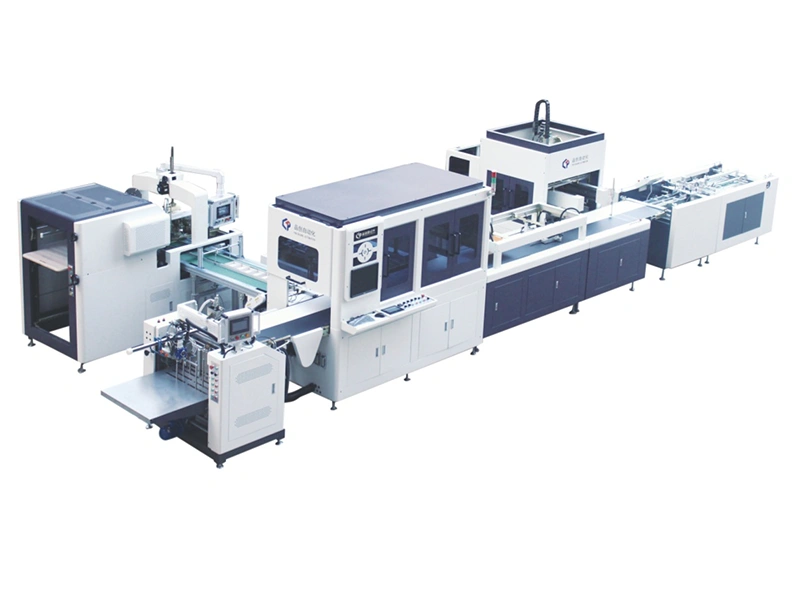
These three headaches often trace back to the same root cause: processes and equipment that were designed for flexibility at low volumes, but can’t scale when a brand takes off. A production manager at a medium-sized European packaging house told me recently, “We bought our semi-auto line when we made 200 boxes a day. At 1,000 boxes, the same line felt like a museum piece.”
The Throughput Lever Nobody Talks About: Motion Consolidation
If you study a time-lapse video of a traditional rigid box line, you’ll notice something striking: the material itself spends more time being transferred than being processed. A board is picked, placed on a conveyor, picked again for wrapping, moved to the press, and stacked. Each pick-and-place cycle adds 3–5 seconds. Over 1,000 boxes, that’s nearly an hour and a half of pure material movement—zero value added.
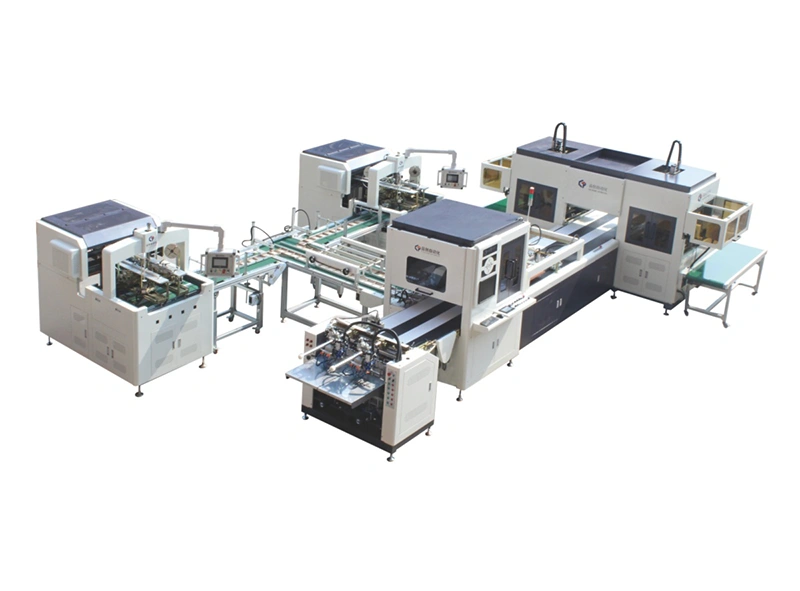
This is where the concept of motion consolidation changes the game. Instead of separate stations for forming, wrapping, and pressing, modern production cells combine these steps into a single continuous flow. The board is located once, wrapped with a servo-controlled pressing mechanism, and discharged ready for inspection—without intermediate queuing.
When a forming and wrapping sequence happens in one indexed cycle rather than across three independent work cells, the throughput gain isn’t incremental. It’s step-change. One manufacturer who shifted to such an integrated automatic rigid box line saw their daily output rise from 900 to 2,200 units in the same floor footprint, primarily because the system eliminated the stop-start rhythm that plagued their old setup. (This is your first chance to explore how motion consolidation might look on your floor.)
Precision Gluing: Where Science Meets Output
Glue application is one of those processes that gets treated as an art rather than a science. “Listen to the hiss of the nozzle,” a veteran operator might say. The problem is, nozzle hiss doesn’t translate to process capability.
For consistent output, glue deposition must be treated as a controlled parameter, not a manual skill. Leading luxury brands now specify a Cpk (Process Capability Index) of 1.33 or higher for glue bead width and placement, in line with the statistical process control methods outlined in ISO 11462-1. Achieving that level of control manually is nearly impossible over an 8-hour shift, especially with varying ambient humidity affecting glue viscosity.
Closed-loop gluing systems—where a sensor measures bead width in real time and adjusts nozzle pressure accordingly—can sustain a Cpk above 1.5 even at cycle speeds of 25–30 boxes per minute. The result isn’t just fewer rejects; it’s a dramatic reduction in the micro-stops that operators used to fix glue sputter. During a packaging efficiency roundtable at Interpack 2023, a production director shared an insight that stuck with me: “Every second your operator spends tweaking a glue nozzle is a second the line isn’t producing a box you can sell.”
If you’re evaluating a move toward closed-loop control, it may make sense to look at a vision-guided wrapping and pressing module that marries glue precision with automatic optical inspection, so deviation is caught and corrected before a single reject box is completed. This kind of inline quality assurance turns what used to be an offline inspection bottleneck into a real-time process monitor.
The Case for Data-Driven Line Management
Another quiet killer of output is the “adjust and hope” maintenance culture. When a semi-automatic machine begins producing boxes with slightly rounded corners, the operator might tweak the press timer by half a second. If that doesn’t work, they tweak the pressure. Over a month, a single machine can accumulate dozens of micro-adjustments that drift it further away from the original process recipe.
Predictive and prescriptive maintenance approaches, powered by simple production sensors, change the conversation. Vibration sensors on press cylinders, torque monitors on servo motors, and cycle time logs can flag issues before they become output drops. One packaging plant in the Asia-Pacific region reduced unplanned downtime by 37% in six months simply by installing temperature probes on their glue reservoirs and tracking the correlation between ambient temperature, glue viscosity, and reject rate. No black magic—just straightforward data analysis that restored a predictable 2,200-box shift.
Putting It All Together: A Practical Week-by-Week Recovery Plan
Rather than overhauling everything at once, use a phased approach to claw back lost output:
-
Week 1 – Time Study: Film your entire line for one full shift. Categorize every minute into “processing,” “waiting,” “rework,” and “changeover.” You’ll likely find that the processing percentage is shockingly low.
-
Week 2 – Stabilize the Glue Loop: Work with your adhesive supplier to define the optimal viscosity window for your shop’s temperature and humidity. Install an entry-level temperature-controlled glue reservoir if you don’t have one. The payback on output consistency alone often justifies the cost within a quarter.
-
Week 3 – Reduce In-Process Inventory: Challenge the assumption that you need buffer stacks between stations. Try pulling one station at a time closer to the previous one to create a pseudo-continuous flow. Measure the impact on throughput.
-
Week 4 – Make a Capital Decision: By this point, the data will tell you whether the bottleneck is mechanical or procedural. If your motion study shows that 40% of cycle time is spent in transfers and manual adjustments, it may be time to consider a dedicated forming line designed for throughput, not just occasional flexibility.
From Bottleneck to Benchmark
Low output doesn’t fix itself, and the tools to diagnose and resolve it are more accessible than ever. Whether you start with a simple time study or move directly toward automation, the core principle is the same: treat output as a measurable system, not a heroic individual effort.
If you’d like to move beyond piecemeal fixes and look at a system built from the ground up around motion consolidation and closed-loop precision, Pinchuang’s automated box forming cell has helped several manufacturers break through the 2,000-box-per-day ceiling while holding the aesthetic standards that premium brands demand. Visit the page to explore real production line configurations and throughput data.
Disclaimer: The performance figures mentioned in this article are based on publicly available benchmark data, industry roundtables, and typical production conditions. Individual results will vary depending on box complexity, material properties, facility layout, and operator training. Always conduct a thorough throughput analysis of your specific product mix before making capital equipment decisions.