
 English
 Español
 May 19,2026
If you run a packaging facility or are scaling up a box manufacturing line, you’ve likely hit a common crossroad: your client needs a beautifully finished luxury box, yet your shop floor is optimized for high-speed folding cartons. You stare at the spec sheet and wonder — do I need a different machine entirely? The answer almost always lies in the fundamental divide between a rigid box former and a folder gluer. Confusing the two can lead to crushed corners, scrapped materials, and disappointed premium customers.
Getting this choice right starts with understanding that these machines solve fundamentally different packaging problems. While both are cornerstones of modern box production, their output, mechanics, and the markets they serve rarely overlap. Before diving into the technical specs, it helps to visualize the end goal: rigid boxes are gift boxes and high-end electronics packaging that keep their shape even when empty; folding cartons are the flat-shipped cereal boxes or pharmaceutical cartons that need erecting. For manufacturers who want to move into the luxury unboxing experience, investing in an automated rigid box production system is often the first serious step.
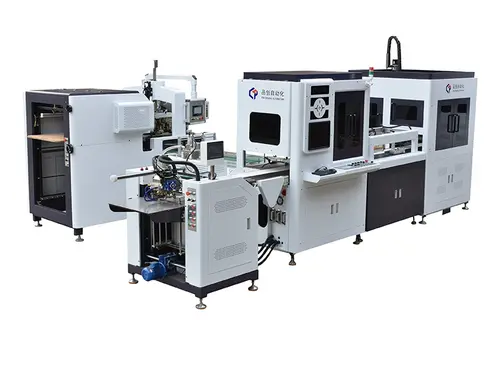
The Core Mechanical Philosophy: Forming vs. Folding
At its heart, a rigid former — sometimes called a rigid box making machine — constructs a box from pre-cut sheets of greyboard or chipboard, wrapping them with decorative paper, and gluing them around a form to create a non-collapsible structure. It is an assembly process involving wrapping, pressing, and corner-tucking. The result is a box that cannot be folded flat without destroying it.
A folder gluer, by contrast, takes a die-cut, pre-printed flat carton blank, folds along pre-creased lines, and applies adhesive to a side seam or bottom flaps. The output is still collapsible, shipped flat, and erected later — usually on a client’s filling line. It is a folding and gluing process, not a forming and wrapping one.
This mechanical difference dictates everything else: speed, material handling, setup time, and the very nature of the box you can deliver.
Detailed Head-to-Head: 6 Dimensions That Matter on Your Shop Floor
Understanding the theory is one thing, but making a purchase decision comes down to production metrics. Let’s break down the key comparison points.
| Dimension | Rigid Former (Rigid Box Machine) | Folder Gluer |
| Box Type Produced | Non-collapsible setup boxes, gift boxes, phone boxes, shoeboxes, watch boxes. | Collapsible folding cartons, straight-line cartons, lock-bottom boxes, 4/6-corner boxes. |
| Material | Rigid greyboard/chipboard (typically 1–3mm), wrapped with printed paper, leather, or fabric. | Folding boxboard, solid bleached sulphate, corrugated E-flute, 200–600 gsm paperboard. |
| Assembly Mechanism | Wrapping and gluing of cover material around a board form, corner pressing, magnetic closure insertion. | Folding along creases, side-seam gluing, optional bottom closure, pre-breaking. |
| Typical Speed | 15–40 boxes/min, depending on automation level and box complexity. One-piece smartformers can reach higher speeds. | 150–400 m/min, often measured in linear belt speed, translating to tens of thousands of cartons per hour. |
| Changeover Time | Can be 15–45 minutes between box sizes, involving mechanical part adjustments, wrapping alignment, and glue pattern changes. | Often 10–20 minutes, highly modular with motorized adjustments on modern machines. |
| Core Precision Metric | Wrapping accuracy, corner sharpness (±0.2 mm material placement), lid-to-base fit consistency. | Folding accuracy, glue line precision, bar code readability after folding. |
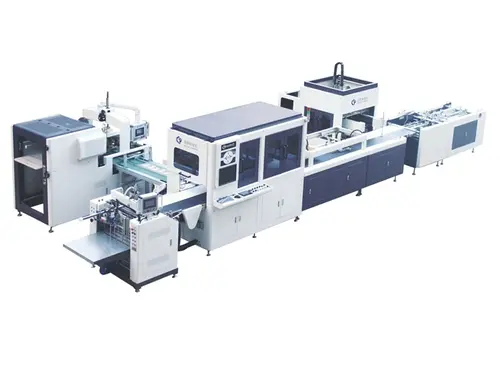
Speed is often the most misunderstood spec. Buyers used to folder gluer throughput might balk at 30 boxes per minute, not realizing that a rigid former handles multiple materials and performs intricate wrapping that no folder gluer could replicate. In premium packaging, output value per unit is far more relevant than raw piece count.
Precision and Quality: Why “Straight Enough” Doesn’t Work for Rigid Boxes
If you’re producing a medical leaflet carton on a folder gluer, a glue seam drift of 0.5 mm might still be within commercial tolerance. If you’re building a matte black luxury phone box on a rigid box machine, that same drift creates a visible glue line and a soft corner — immediate rejects. The quality expectation bifurcates the technology.
Rigid formers use precise forming dies, vacuum positioning systems, and multi-point wrapping stations to align cover material perfectly with board edges. A well-tuned high-precision box forming solution will deliver corners that are crisp and paper patterns that match seamlessly across the lid and base. For unboxing videos that are now part of a brand’s marketing, this sharpness is non-negotiable. Many manufacturers following ASTM D5118 standards for fibreboard shipping containers still find themselves needing to define internal specifications for luxury rigid boxes, as standard corrugated standards don’t address aesthetic corner wrapping.
Setup Complexity and Operator Skills
Walk into a carton plant, and you’ll see folder gluer operators making rapid adjustments via touchscreen: rememorizing fold hooks, adjusting stacker delivery, fine-tuning glue application. The machine’s high speed means they produce a lot in a short time, but they are tweaking a folding process.
In a rigid box facility, setup is more akin to a mechanical assembly line configuration. Changing from a book-style box to a telescoping lid involves swapping forming dies, adjusting paper feeders, and calibrating the pressure rollers. The learning curve can be steeper, but the process is visually intuitive: you see a flat board enter and a finished box emerge after wrapping. Experienced operators often come from the luxury print finishing sector, not from conventional packaging. If you’re building a new team, factor in the training investment for rigid box production — or look for equipment with quick-change tooling and guided recipe management to flatten that learning curve.
Cost Structure and ROI Logic
A folder gluer is often justified by volume: cents per carton, profitability through utilization. A rigid former is justified by value addition: a simple chipboard box that costs 0.30inmaterialscanbecomea0.30inmaterialscanbecomea2.50 finished luxury item after precise wrapping. The machine’s ROI lies in converting raw board and paper into high-margin branded boxes, not in minimizing per-unit seconds.
It’s tempting to view a rigid box machine as having a higher cost, but consider the alternative: manual box wrapping. Hand-made premium boxes are slow, inconsistent, and difficult to scale. An automated setup not only increases capacity but dramatically reduces the defect rate — especially on large-format boxes that are punishing to assemble by hand.
When They Overlap — And Why You Still Need Both
A rare crossover exists: some advanced folder gluers can produce “rigid-style” collapsible boxes using a crash-lock or tab system, and some rigid formers can handle thinner materials for simpler box designs. However, these are compromises. A collapsible rigid-style box lacks the structural weight and premium hand-feel; a thin material run on a rigid former wastes its wrapping precision. For most operations serving distinct market segments — mass-market cartons and premium luxury packaging — running two separate dedicated machines is the only way to deliver on both promises.
Making the Right Call for Your Next Investment
Before requesting quotes, map your current and aspirational product mix. Ask yourself:
-
Are 80% of your requests for folding cartons, with a handful of luxury box inquiries you currently outsource? Stick with a high-speed folder gluer and maintain that subcontractor relationship.
-
Are you seeing margin erosion in folding cartons but a steady stream of premium gift box orders with 3x better profitability? That’s the signal to bring rigid forming in-house.
-
Do you already operate a rigid former but need to speed up small-format box production for cosmetics? You may be looking at a specialized smartformer rather than a second general-purpose machine.
If your trajectory points toward becoming a one-stop premium packaging supplier, the integration of both technologies under one roof gives you supply chain control that pure converters can’t match. You can turn a shoebox project from carton to rigid without changing vendors, which brands love.
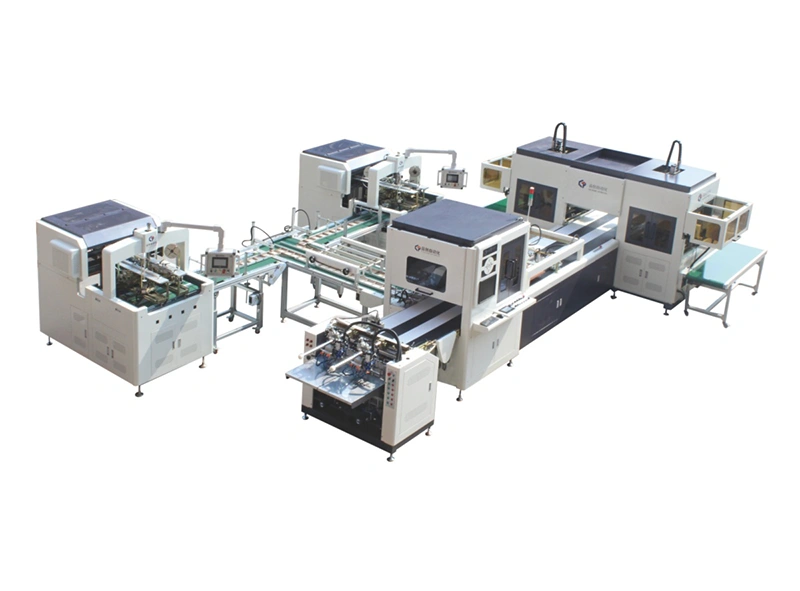
If you’re leaning toward entering the luxury segment or scaling your existing rigid box line, it’s worth looking closely at purpose-built equipment that prioritizes fast changeover and corner precision. The PINCHUANG lineup, for instance, includes versatile rigid box assembly configurations designed to handle board thicknesses from 0.8 mm to 3 mm and integrate with automated feeding and stacking systems. Whether you’re producing telescoping lids, drawer boxes, or magnetic closure cases, having a single platform that can adapt significantly reduces your tooling costs per SKU. For a detailed walk-around of the modular stations, feel free to view the full machine specifications here.
A Final Word on Process Ownership
The difference between a rigid former and a folder gluer is not just technical — it’s a statement about where your business sits in the packaging value chain. One promises speed and commodity efficiency; the other promises craftsmanship and brand elevation. Many successful packaging firms master both, but they never treat them as interchangeable. Keep your customers’ unboxing moment in mind, and your equipment choice will rarely be wrong.